ABFM Doctoral Student Profile: Kattalina Berriochoa

In preparation for ABFM’s upcoming conference in Denver, I am doing a series of profiles on the doctoral students on the job market.

Kattalina Berriochoa (McCormack Graduate School of Policy & Global Studies, UMass-Boston) is presenting “Analyzing Micro-Logic: Why Public Spending on Education Varies Across the Urban Rural Divide” in the 9:45 session on Friday. She presented a similar work at Georgia State’s “Next Generation Public Finance” conference back in the spring. Her dissertation explores how place (particularly urban, rural, suburban places) shapes preferences of the individual for redistributive financing.  Here is the abstract on one of her dissertation essays, “Public Finance for Schools: Analyzing Collective Preferences Across Place“:

The persistent urban-rural divide creates a host of economic disadvantages and interstate inequalities, including but not limited to funding variation for public education. This study provides an analysis local bond elections in Texas, with a focus on the urban and rural divide. This analysis shows that that odds and probability of passing a school bond can differ across place. The focus on place is to analyze the occurrence of preference variation where individuals do not always collectively demand more from government but rather often reject more spending on public goods. First, using data collected on over 2,000 bond elections in the state of Texas over the years 2000-2016, logistical regression models are estimated to determine the factors associated with the likelihood of passing a school district bond by local district election. Second, I analyze how collective preferences may be shaped differently across place with the employment of the Oaxaca-Blinder decomposition model. I find that across place (urban and rural), the effect of income has a relatively neutral impact. Across place, the increase of median age over time has a negative impact on the probability of passing a bond election and the increase of diversity among students in public schools is found to increase the likelihood of bond passage. This final effect of race is most substantial in rural places. Generally, I find that the impact of variables in the urban and rural model behave in similar directions. Variation results from the magnitude of effects, where parameters are found to hold larger sway in more rural places, compared to urban counterparts. I find additional support for this finding with the employment of a decomposition model, which finds that when the key variables are taken into account, the magnitude of age, income, and race differ considerably on the collective preferences of voters regarding bond elections across place. The goal of this study is to highlight the way in which preferences are shaped by place and how that may feed back into the distribution of funding for public goods.

Berriochoa’s work on public opinion, public finance, and what drives diverging preferences between urban and rural communities sounds informative to understanding national politics at large. She lists additional works in progress on gender diversity in local government leadership, and the role of professional identity and legitimacy of leaders in government regulation. She has a paper under review that examines media consumption by the Basque Diaspora in the United States. In addition to her works in progress, Berriochoa describes an interest in language policy and teaches Basque, and has several publications related to teaching.

Find more of Kattalina Berriochoa’s research, teaching, and interests here.

European Budgetary Rules, Deficits, and GDP Growth

There are two new articles that are interesting to pair together, one in Southern Economic Journal and the other in Public Budgeting and Finance.  I’m just going to put their title and abstract below:

Public budgetary rules and GDP growth: An empirical study on OECD and twelve european countries.” Southern Economic Journal, by Elton Beqiraj, Silvia Fedeli, and Francesco Forte. Abstract:

We study the long‐term effects of budgetary rules on GDP growth rate and analyse the determinants of the short‐term GDP growth dynamics. For both a sample of 19 OECD and a subsample of 12 European countries, we show that, in the long run, improvements in the cyclically adjusted budget balance, as well as increases in the tax burden, have negative effects on GDP growth. The highest effect of fiscal policy on GDP growth would be obtained if the structural deficits were used to increase the market size by reducing the tax burden. In line with Barro (1990), a deficit‐financed reduction of tax burden has a stronger effect for European than for OECD countries, because in Europe the government size with respect to market size is too large. Therefore, if GDP growth is a dominant policy objective, in Europe specific actions should redress the 2012 Treaty toward a reduction of the tax burden.

“Budgetary Balances Adjustments From Governmental Accounting to National Accounts in EU Countries: Can Deficits Be Prone to Management?” Public Budgeting & Finance, by Susana Jorge, Maria Antonia Jesus, Raul Laureano.

European Union (EU) countries are required to achieve deficit targets and are thus incentivized to use tools to keep within budgetary limits. This paper argues that accounting discretion might be used to manage some adjustments made during the translation of data from Governmental Accounting (GA) into National Accounts (NA), to window‐dress the final deficit/surplus reported to EUROSTAT. The empirical research shows there are certain circumstances that might facilitate the use of GA–NA “adjustment discretion.” EU authorities must pay special attention to these conditions to ensure the reliability of reported deficits. The main findings of this paper could also assist in future efforts to improve the integrity of the adjustment process.


Yang on Contagion Effects from Municipal Bankruptcy

One argument for state regulation of local government financial management (e.g. limits on debt issuance, limits on expenditure growth, etc.) is the plausibility of negative fiscal externalities.  That municipal bankruptcies might spillover and contaminate other local governments is a popular example, so much so that it even got its own plotline in the show Parks and RecreationThe argument is that bankruptcy will cause investors to look more suspiciously at, and accordingly demand higher risk premiums from, the municipal bond market that will drive up the borrowing cost for other local governments.

Public Administration Review has a new research article by Lang Yang (George Washington University) titled “Negative Externality of Fiscal Problems: Dissecting the Contagion Effect of Municipal Bankruptcy.” The paper revisits one of the more extreme cases of municipal bankruptcy, Jefferson County (AL) in 2011, and attempts to determine the presence of these contagion effects. She provides a helpful taxonomy for types of contagion effects that are either “general” or “case specific” that can be operationalized as hypothesis. These are summarized in her Table 1:

YangTable1

Using a difference-in-differences regression at other local governments in Alabama she finds no evidence for the general contagion effects: Being in Alabama, or geographically closer to Jefferson County, had no adverse effects on municipal borrowing costs. Importantly, this may be because Jefferson County’s bankruptcy cause was not driven by local or regional economic factors, but rather “mismanagement of a large infrastructure projects and use of unconventional financial instruments” (page 2). However, this is also important because she finds some evidence that borrowing costs declining for other local governments, as she does some additional investigation (see page 8 and Table 6) to show that it seems investors with a preference for Alabama simply reallocated their loanable funds to other local municipalities.

Yang does find evidence of case specific contagion factors, however, in that she finds that other local governments that similarly shared a “full faith and credit” commitment were reevaluated by local investors to the tune of 6 or 7 basis points on their borrowing costs. That is, local governments trying to borrow general obligation debt without the backing of committed taxes had been revealed as potentially unsecured credit in a bankruptcy proceeding.

It is a thoughtful paper with important implications for the motivation of state policy over local governments, particularly with respect to bankruptcy protection.

NTA Announces Holland Award

The 2018 recipient of the Daniel M. Holland Medal is Michael Keen of the IMF. From their announcement:

The National Tax Association is pleased to announce the 2018 award winner, Michael Keen, International Monetary Fund.

Michael “Mick” Keen, Deputy Director of the Fiscal Affairs Department at the International Monetary Fund, has made fundamental contributions to the theory and practice of public finance, advancing our understanding of complex issues in a clear and insightful manner. His work combines impeccable academic rigor with deep policy relevance.

Mick’s work spans a wide range of important topics in public finance, notably including tax competition and tax coordination, the value-added tax, tax issues in developing countries, the tax treatment of the financial sector, environmental tax policy, corporate income taxation, fiscal federalism, and the interplay between tax and trade policy. His work has been published in leading economic journals; he has also written and edited several books, including The Modern VAT; the Taxation of Petroleum and Minerals; and Digital Revolutions in Public Finance. His work has pushed forward the frontier of both theoretical and empirical research in public finance.

Before joining the IMF, he was Professor of Economics at the University of Essex. Mick was awarded the CESifo-IIPF Musgrave prize in 2010, and is Honorary President of the International Institute of Public Finance. He has served on the Board of the National Tax Association, and on the editorial boards of several journals, including International Tax and Public Finance, of which he was joint founder.

Mick’s work will be celebrated and he will receive the award in November at NTA’s 111th Annual Conference on Taxation in New Orleans.

The Daniel M. Holland Medal was created in 1993 in memory of Dan Holland, a Professor of Economics at the Massachusetts Institute of Technology Sloan School of Management. He wrote several books and numerous articles on a wide range of topics in taxation and served as a consultant to the U.S. Department of the Treasury, foreign governments, and private companies. Dan was a leading figure in the NTA for many years, serving as president in 1988–1989 and as editor of the National Tax Journal for 25 years from 1966–1991. The Holland Medal is the most prestigious award given by the NTA, as it recognizes lifetime achievement in the study of the theory and practice of public finance. A committee of NTA members constituted by the Board of Directors makes a formal nomination of the award recipient each year for approval by the Board, and the medal is awarded at the Annual Conference on Taxation.

New issue of International Tax & Public Finance

The October 2018 issue of International Tax & Public Finance has been released. Below are the table of contents. The working paper version of the Richard Bird essay was previously discussed on this blog here.

Optimal family taxation and income inequality 
Patricia Apps, Ray Rees

Sub-metropolitan tax competition with household and capital mobility 
Tidiane Ly

A test of fiscal sustainability in the EU countries 
Kyung-woo Lee, Jong-Hee Kim, Taeyoon Sung

Specific versus ad valorem taxes in the presence of cost and quality differences 
Kuang-Cheng Andy Wang, Ping-Yao Chou, Wen-Jung Liang

Distributional and revenue effects of a tax shift from labor to property
Jörg Paetzold, Markus Tiefenbacher

Is capital back? The role of land ownership and savings behavior 
Max Franks, David Klenert, Anselm Schultes

Tax treaties and foreign direct investment: a network approach 
Sunghoon Hong

Optimal tax routing: network analysis of FDI diversion 
Maarten van ‘t Riet, Arjan Lejour

Are global taxes feasible?
Richard M. Bird

New Issue of Public Budgeting & Finance

The Fall 2018 issue of Public Budgeting & Finance is now available. Here is the Table of Contents:

Fiscal Institutional Externalities: The Negative Effects of Local Tax and Expenditure Limits on Municipal Budgetary Solvency.” Benedict S. Jimenez.

Use of Special Assessments by Municipal Governments in the Chicago Metropolitan Area: Is Leviathan Tamed?” Rebecca Hendrick & Shu Wang.

Budget Reforms in Times of Austerity: A Centralization Cascade in Danish Central Government?” Mads Bøge Kristiansen

Why Are We Lagging Behind? An Empirical Analysis of Municipal Capital Spending in the United States.” Wen Wang & Yonghong Wu

Book Review: Government Budgeting and Expenditure Management: Principles and International Practice, by Salvatore Schiavo‐Campo. New York, NY: Routledge,2017.” Vito Tanzi

Labor Day 2018: Tax Incidence and Unions

If not an outright monopoly of labor, unions are at least a form of imperfect competition in the labor market. Theories of tax incidences are much more varied are hard to generalize as competition diminishes. Consider a monopolist with a linear demand curve, then the monopolist will bear 1/2 the economic incidence.(a) However, the monopolist will be able to overshift onto output consumers if the demand curve lends itself to optimal mark-up rules, as in the case of a constant elasticity demand function.(b) In an oligopoly market, there is no widely accepted theory of firm behavior and therefore no generalizations of what tax incidence may be (see Stiglitz & Rosengard, Economics of the Public Sector 4th edition, p. 556).

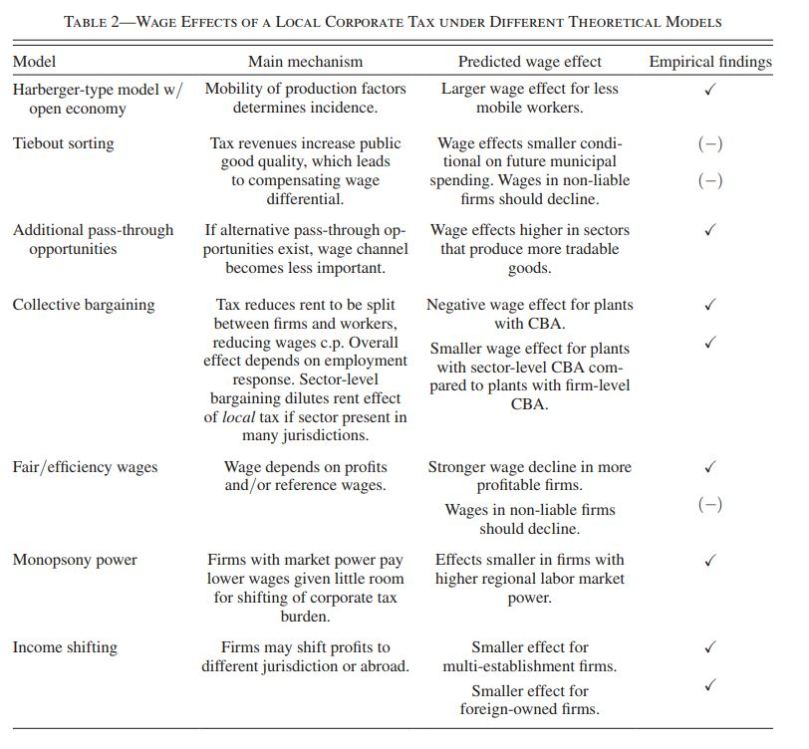
One of the interesting areas of research in recent years has been on the labor incidence of the corporate income tax, and generally it seems unions bear a substantive portion of the tax’s burden. In this NBER Paper by Felix and Hines (“Corporate Taxes and Union Wages in the United States”, 2009) find that unions capture about half of the gains of reductions in state corporate income taxes. Similarly, a recent American Economic Review article by Fuest, Peichl, and Siegloch uses a rich employer-employee linked administrative dataset from Germany and finds worker wages absorb about half the burden of the corporate income tax, but that there is considerable heterogeneity across a whole variety of wage-setting institutions in the country. The findings are difficult to summarize, but they helpfully provide this Table where their last column summarizes their corresponding empirical findings:

Tab2Fuest

Notes:

(a) This one-half result falls out of the linear demand function of the form p=A-bq yields a total revenue function of p*q=Aq-bq^2. Taking the derivative yields a marginal revenue curve of MR=A-2q.

(b) In a CES demand function, the optimal mark-up rule yields p=[(e)/(e-1)]*MC, where e is the price elasticity of demand in absolute value. The function is defined when e>1, so if e=2 then price is double marginal cost [2/(2-1)=2]. Adding a tax to marginal cost would cause the change in price to be a multiplier increase based on that mark-up, resulting in overshifting.

PB&F Virtual Roundtable on Retail Sales Tax

Next week Public Budgeting and Finance is hosting its second Virtual Roundtable, this time on the Retail Sales Tax.

Moderating the discussion is Whitney Afonso (UNC-Chapel Hill), who has published numerous papers on sales taxes, including this 2015 winner of the Jesse Burkhead Award for the year’s best article in PB&F.

Panelists include: Cynthia Rogers (University of Oklahoma) who has done some extremely influential work on horizontal and vertical tax competition in sales taxes; Don Bruce (University of Tennessee-Knoxville) who is an expert on state taxation generally but was also among the first scholars to work on e-commerce and sales taxation in the early 2000’s; and Barry Boardman, a longtime professional economist in the public sector who is currently the Chief Economist of the North Carolina General Assembly.

Date: Thursday, September 6, 2018
Time: 1PM EST
To Join: 

Call for Papers: Taxation in the Digital Economy

The CESifo Group in Munich is hosting a 2019 summer conference in Italy on the subject. Here is the website, below are the specs:

Venice Summer Institute 2019: Taxation in the Digital Economy: Theory and Evidence

Time: Jun 3, 2019 9 AM – Jun 4, 2019 2 PM

Address: San Servolo, Venice, Italy

Recent technological changes challenge fiscal systems. For instance, the internet allows consumers to shift purchases from physical firms to online retailers, which possibly results in the creation of digital products that have no “physical” component. At the same time, internet platforms use different business models compared to standard ones. Digital platforms like Netflix and Google connect different groups of customers and thereby use pricing strategies for their products that reflect how desirable one group is for the other groups. The multi-sidedness of the platform and the global outreach of the platforms might lead to unconventional incidence and efficiency effects of taxes. These technological changes have important policy implications. For example, the issue of how value creation by digital platforms might be allocated to the various jurisdictions for corporate taxation purposes is currently the subject of hotly debated reforms proposed by the European Commission. Taxation of online sales is the subject of U.S. federal legislation such as the Marketplace Fairness Act and recent Supreme Court action. The workshop aims to combine theoretical research and empirical evidence of taxation in the digital economy. The goal is to facilitate interactions between researchers focused on industrial organization, i.e., responses of prices/firms and public finance economists interested in the effect of the digital economy on fiscal systems.

Keynote speakers: Jean-Charles Rochet, University of Zurich, and Joel Waldfogel, University of Minnesota

Scientific organiser(s): Marko Köthenbürger, David R. Agrawal


Program for the National Tax Association’s Annual Conference

The conference webpage can be seen here. Programs at a glance below. I’m quite pleased to be presenting in the first session on health insurance with no subsequent discussant duties.

THURSDAY, NOVEMBER 15

8:30-10:00 am

Concurrent Sessions

• Behavioral Responses to Taxation
• Debt, Equity, and International Taxation
• Field Experiments in Tax Administration
• Health Insurance: New Evidence from Policy Changes
• Household Saving and Portfolio Behavior
• Policy Innovations in Developing Countries
• Recent Developments in State and Local Public Finance
• Regional Implications of Fiscal/Monetary Stimulus
• Response to Policy
• Tax Administration and Compliance: Regulatory Design

10:00-10:15 am

Coffee Break

10:15-11:45 am

Concurrent Sessions

• As Uncertain As Local Taxes
• Bunching Evidence on Responses to Taxation
• Charity and Public Goods 1
• Consequences of Corporate Tax Reform
• Environmental Taxes, Cross-border effects and Government Interaction
• Fiscal Policy Transmission
• Investment and International Tax Incentives
• Property Taxes and Local Debt
• Shareholder Taxes and the Firm
• The Link Between Secondary and Post-Secondary Education and the Labor Market

12:00-1:30 pm

Luncheon

Keynote Speaker: Michael Devereux, Director of the Oxford University Centre for Business Taxation, Professor of Business Taxation, Saïd Business School, University of Oxford

Presentation of Awards:

  • Outstanding Doctoral Dissertation in Government Finance and Taxation
  • National Tax Journal Referee of the Year Award
  • National Tax Journal Richard Musgrave Prize
1:45-3:15 pm

Concurrent Sessions

• Corporate Innovation and Start-Ups
• Digital Aspects of International Tax
• Income Mobility and Expectations
• Information, Engagement, and Compliance
• Investment in K-12 Education
• Measurement of Tax Planning, Tax Planning and Uncertainty
• Optimal Tax 1
• Pension Policy and Saving
• Responses to Local Taxation
• Responses to Personal Taxation
• Tax Design: Withholding, User Fees, and Consumption Taxes

3:15-3:45 pm

Coffee Break

3:45-5:15 pm

Concurrent Sessions

• Capital and Labor
• Charity and Public Goods 2
• Corporate Taxes and Aggregate Investment
• Health Policy 2
• International Tax Competition
• Labor Supply and Tax Rates
• Local Public Finance Abroad
• Optimal Tax 2
• Tax Administration Issues Affecting Low Income Taxpayers
• Taxes on Consumption in Developing Countries
• Topics in Political Economy

5:15-6:15 pm

Annual Meeting of the National Tax Association

6:15 – 7:30 pm

Thursday Night Reception

FRIDAY, NOVEMBER 16

7:15-8:15 am

Graduate Student Breakfast

8:30-10:00 am

Concurrent Sessions

• Financial Reporting and Auditing
• Health Policy
• Misreporting and Tax Compliance in Developing Countries
• Natural Experiments and Demographic Variation in Compliance
• Optimal Tax 3
• Policy Impacts on Retirement
• Politics and Policy Outcomes
• Profit Shifting After Territorial
• State and Local Tax Workarounds
• Using Experiments to Inform Tax Policy
• Wayfair: The Way Forward

10:00-10:15 am

Coffee Break

10:15-11:45 pm

General Session

Fiscal Policy after the Midterm Elections

Moderator: William Gale, Brookings Institution

Panelists:  Michael Graetz (Columbia Law School);  James R. Hines Jr. (University of Michigan);  Mark Prater (PricewaterhouseCoopers);  Kim Rueben (Urban-Brookings Tax Policy Center); Betsey Stevenson (University of Michigan)

12:00-1:30 pm

Luncheon

Keynote: Hilary Hoynes, Professor of Economics and Public Policy, University of California Berkeley

Presentation of Steven D. Gold Award

1:45-3:15 pm

Concurrent Sessions

• Compliance, Enforcement, and Dynamic Responses
• Infrastructure and Local Debt
• Legal Perspectives on the TCJA
• M&A and Supply Chain
• Optimal Tax 4
• Rethinking the Value of Public Policy
• Safety Net Programs and Labor Markets
• Student Loans and Repayment
• Taxation, Public Goods and Externalities
• The 2017 Tax Bill and the Future of Tax Reform

3:15-3:45 pm

Coffee Break

3:45-5:15 pm

General Session

Plenary Panel: In honor of Michael Keen, 2018 Holland Award Recipient

Session Chair: Victoria Perry, International Monetary Fund

Panelists: Michael Devereux (Oxford University);  Li Liu (International Monetary Fund);  Joel Slemrod (University of Michigan);  Ruud De Mooij (International Monetary Fund)

5:15-6:15 pm Graduate Student Poster Session
5:15-6:30 pm

Friday Night Reception in honor of Holland and Steve Gold Award Recipients

SATURDAY, NOVEMBER 17

8:30-10:00 am

Concurrent Sessions

• Agency Conflicts
• Behavioral Biases and Corrective Taxation
• Benefit Take-Up
• Distributional Analysis After the 2017 Tax Act: Findings and Directions for Research
• Fiscal Policy and the Labor Market
• Local Expenditures
• Optimal Tax 5
• Saving Responses to Pension Design
• TCJA and Related
• Transparency and Tax Avoidance

10:00-10:15 am

Coffee Break

10:15-11:45 am

Concurrent Sessions

• Earnings and the Firm-Employee Relationship
• Financial Reporting II
• Housing, Commercial Property and Local Taxes
• Inequality and Taxation
• New Empirical Perspectives on the Aggregate Effects of Fiscal Policy
• On Tax Havens
• Post-secondary Education Access and Returns
• Specific Provisions
• Tax Preparers and Tax Administration
• Taxation with Non-standard Utility Functions

12:00 pm

Lunch
(Attendee’s choice — Conference does not provide lunch)

1:00-2:30 pm

Short Course: New Research on Business Taxation

Presenter: Eric Zwick, Associate Professor of Finance, University of Chicago Booth School of Business
Sponsored by the University of Michigan Office of Tax Policy Research