Call for Papers: VIII Ibero-American Conference on Local Financing (Mexico City)

The conference is October 1-2, 2019, hosted by the Universidad Iberoamericana and the Center for Economic Reserach and Teaching (CIDE).

The Conference continues a joint initiative of academics and policy specialists in local finance that began in Spain in 2011 and subsequently continued in Argentina (2013), Brazil (2014), Chile (2015) , Spain (2016), Argentina (2017), and Colombia (2018).

The objective of the conference is to present a maximum of twelve research papers on topics related to: 1.Fiscal decentralization; 2. Efficiency and quality of sub-national welfare expenditures including public investments; 3. Subnational  tax collection; 4. Management of Sub-national Governments; 5. Debt and subnational financing; and 6. Subnational financing frameworks for climate change within Ibero-American countries (Latin America and Spain).

In previous conferences, a total of 92 papers have been presented, showing a great thematic and geographical coverage, adding to the growing importance of local finances in Latin America and the Caribbean, both in the research agendas and in policy matters. The ultimate goal is to create evidence based policy to improve fiscal systems in the region.

The call for papers seeks research and unpublished studies that, within the general themes listed above, to disclose new findings and research advances on local financing issues in Ibero-American countries. Through an academic selection committee, research papers selected will be invited to present their work in Mexico City October 1 and 2, 2019. This includes travel support and lodging for one professional to participate in the conference.

While the sessions seek to exchange views and policy innovations,  professionals of think tanks, national budget authorities such as national ministries of finance, international organizations, local public officials, and finally academics and students of public policy and public administration, economics public and public finances will likely participate in the audience.  Additionally, a half day will be devoted to a “Workshop on the Challenges of Local Financing” and ideas will be exchanged on the definition of research topics to be addressed in the next JIFL.

Fill out this form to participate.

I appreciate professor Heidi Jane Smith (Universidad Iberoamericana) for both the notice of the conference and the translation above. Do note that the conference itself will be in Spanish.
*Higher Pay, Worse Outcomes? The Impact of Mayoral Wages on Local Government Quality in Peru*

That is the title of an article by Ricardo Pique (Ryerson University) in the Journal of Public Economics. Does raising salary for mayors result in better mayoral performance, or gentrify the pool of candidates in some way? Here is Pique on the evidence from Peru:

In this paper, I study how wages earned by local politicians affect local government quality. To identify the effects, I use caps imposed by the Peruvian central government on mayoral wages as an excluded instrument. The results show that mayoral wages do not improve government performance. In particular, there is a negative impact on public investment implementation and on performance goals set by the central government. Moreover, there is no evidence of a positive effect on politician selection, municipal bureaucratic capacity, and political effort. Wages do strongly affect the local political landscape, increasing political competition and reducing political support for the mayor. These changes may help explain the drop in performance as local authorities may face more political obstacles when implementing their policy agenda. Overall, the results show that higher politician wages need not improve local government quality.

To circumvent endogeneity, the instrument for actual wages paid is the maximum amount the Peruvian central government sets for mayoral wages (through a population based step function). So the identification is going to arrive from populations narrowly passing (or not) the threshold that allows them to offer higher mayoral wages.

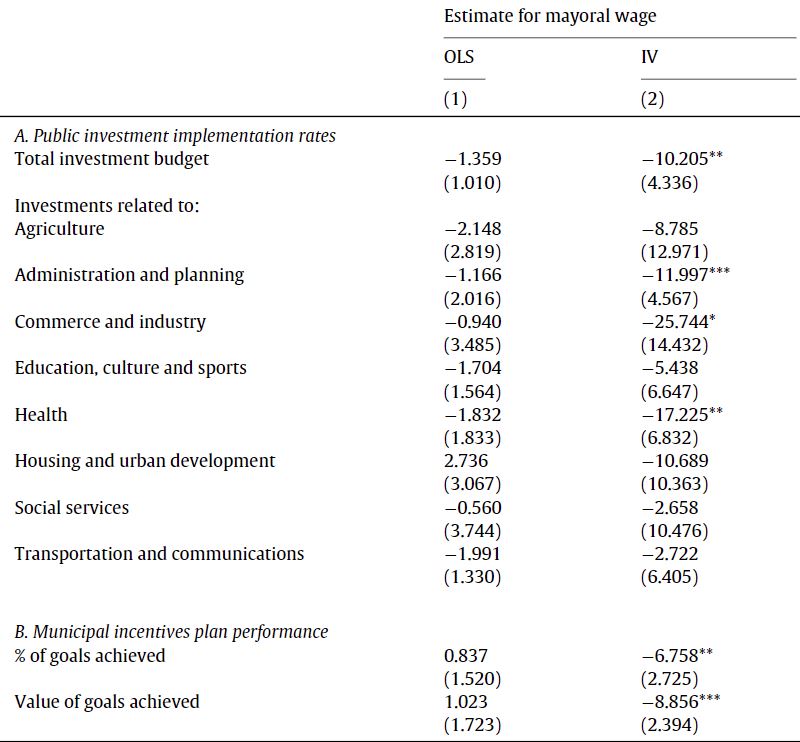
Of course, evaluating public sector performance is an inherently difficult thing to do. There is a large cocktail of dependent variables, and they consistently show that they are negatively affected by getting the inducement into a higher wage. One of the author’s preferred outcome measures is a budget execution rate. According to Pique, Peruvian mayors are significant administrators of investment projects backed by the federal government, so he uses the share of the investment budget that was actually spent (“execution rate”). This was not very intuitive to me, so I’m just going to pull the explanation from footnote 38 on page 9:

Unlike other policy outcomes such as total revenue, investment implementation is within the mayor’s control. Local authorities are constantly pressured by both the central government and the local population to carry out their budgeted investment projects. Both national and local newspapers produce articles comparing the relative performance of local authorities in matters of public investment implementation. Failure to implement budgeted public investment projects can be particularly dangerous amid a weak institutional and political context. Ponce and McClintock (2014) show that low levels of implementation are correlated with more social protests.

Here is a sampling of some of the main results, and of course the study has many robustness checks with a particular interest on whether this gets at performance:

mayerdepvariable

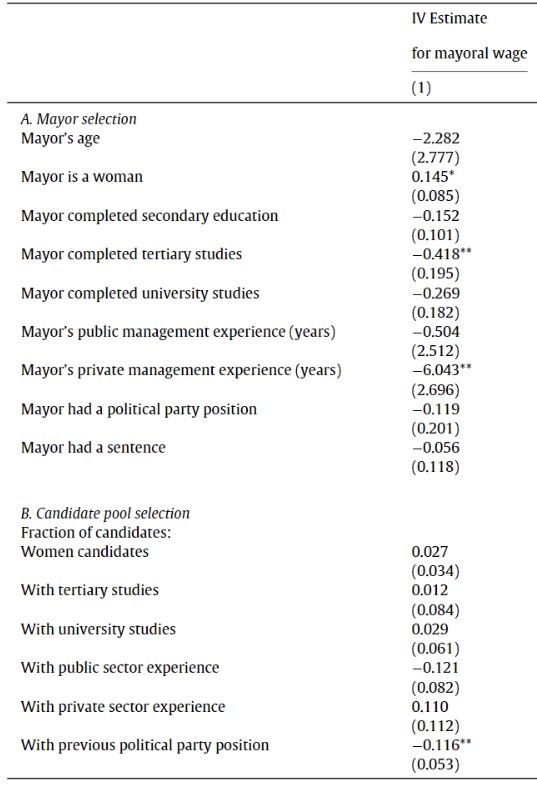
So, broadly, the effect on performance is negative. The question is why, and one possibility is that it undesirably changes the selection of mayors, so a variety of mayor and candidate for mayor attributes are effected by the wage offer. This does not appear to be the case:

mayorattributes

A number of other plausible outcomes are investigated, including bureaucratic capacity, political effort, and political competition, and it seems like political competition (increased number of parties, reduction in winner’s vote share, reduction in public sector experience) is the most plausible explanation in terms of why a change occurs, though it is not terribly clear why this reduces performance rather than increasing it. Pique says the pattern is perhaps most supportive of creating a rising obstructionist party at the local level and this might be a Peru specific outcome. The negative effects on getting mayors with public sector experience shows up in a variety of ways, and I’m somewhat inclined to think of that as an important finding towards explaining what is happening. In my opinion, public service motivation is underrated by the public (albeit overrated by public administration scholars)

There is much of interest and to admire in the paper. For background reading, perhaps consider Besley and Case’s (1995) QJE paper “Does Electoral Accountability Affect Economic Policy Choices?“.

Can Centralized Performance Budgeting Systems Be Useful For Line Ministries? Evidence From Chile

A forthcoming article in Public Budgeting & Finance by Juan Pablo Martinez Guzman (UMD) discusses performance information use in line ministries in Chile. The question whether line ministries use performance information is important because in centralized top-down governance systems they may be perceived as externally imposed and, therefore, resented. The author offers several insights from this detailed case-study based on process-tracing methodologies.

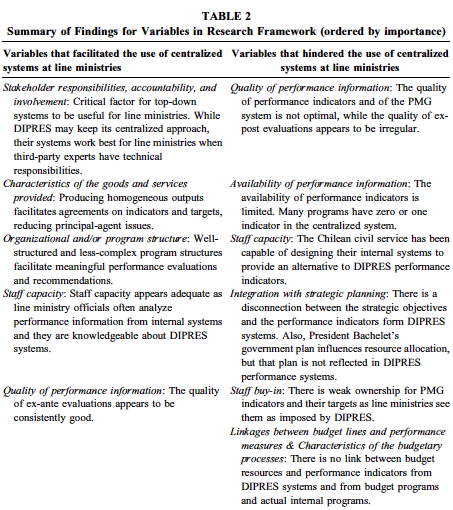
The main findings for variables that either facilitated or hindered the use of centralized performance information systems are presented in table 2.

Overall, it appears that any resentment from line ministries can be overcome by involving third party technical experts, selecting homogenous performance measures, spending sufficient effort for (quality) program structuring, and investing in human capital.

These findings are directly relevant to many other central and regional governance systems around the world that operate in top-down performance regimes. A caveat is, however, each of Chile’s four key performance indicators appear to have emerged from separate waves of performance management reforms in the country. So, the road to performance information use in line ministries in centralized governance systems can run for decades. Martinez Guzman (page 9) writes that:

“performance indicators were the first component of Chile’s performance budgeting system, initially introduced in only five institutions through a pilot plan in 1993. The use of performance indicators expanded quickly to most of Chile’s government agencies, reaching 80 percent of them by the year 1997. From 1998 to 2000, performance indicators were used to determine if institutions would be awarded economic bonuses through the PMG. Because of their linkage to the PMG, performance indicators were excluded from budgetary appendices during the years 1999 and 2000. In 2001, performance indicators were removed from the PMG and restored as budgetary appendices. Finally, in the year 2011, performance indicators were reintroduced as the basis to determine PMG’s variable remunerations, and were also kept as part of the budgetary appendices that are presented to the legislature.”

*Political Parties Do Matter in U.S. Cities … For Their Underfunded Pensions*

That’s a new NBER working paper by Christian Dippel (UCLA), which finds that cities with Democratic mayors are more likely to underfund pensions:

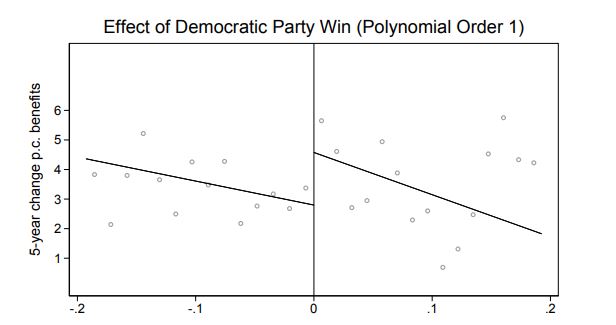
Using data covering a wide range of municipal public-sector pension plans from 1962– 2014, I establish that unfunded pension benefits grow faster under Democratic-party mayors, using a regression discontinuity design (RDD) focusing on narrow mayoral races. Previous evidence shows that parties do not matter for a range of fiscal outcomes in U.S. cities, and suggests this is because Tiebout sorting imposes fiscal discipline. This paper shows that parties do matter for types of fiscal spending where benefits accrue to narrow constituencies and where costs are difficult to observe and understand for tax payers.

Generally the literature shows political parties does not much matter for local government finances, but as the authors here note those studies are typically exploring more visible fiscal outcomes. Here is the discontinuity for the main result (N=1,195):

MayorPension

The paper shows the finding to be robust to a number of subsamples, including plan type (police and fire-fighters), city system (mayor or council managers), and whether the mayor was a challenger or incumbent. The results are most pronounced for plan type, and as the figure shows, the effect is driven by being particularly close to the cut-off. These results imply that it is the result of pork barrel projects to win close elections. With any discontinuity there is concern that the threshold result will be different from the average treatment effect, so we should be a bit hesitant to think that states dominated with one party rule (i.e. no close elections) will have party differences in pension funding.


Tipping the scales: The causes and consequences of administrative spending

An early view article in Public Administration by Darnley et al. evaluates the relationship between external environments of public organizations and administrative intensity. The sample consists of four‐year public universities in the United States from 1998 to 2011. This period is particularly important due to, arguably, growing and excessive levels of “administrative bloat” at public universities in the United States. Such administrative intensity, the authors find, is significantly related to student outcomes.

“Administrative bloat” or intensity “generally refers to the bureaucratic component of an organization and is often measured through relative spending or number of employees.”

Public universities in the US operate in increasingly political environments that may have an impact on organizational size and complexity. External pressure variables such as party control of the state executive and legislative branches, and whether public universities operating in environments with centralized governing boards, are found to be significant covariates of two measures of administrative intensity levels: administrative costs and administrative personnel.

Darnley et al. state that: “Our main independent variables focus on factors in the external political environment. First, we hypothesize that institutions in states with more conservative political principals will face greater pressure to reduce administrative intensity, as these are often issues discussed in conservative platforms (at least in the context of the United States). As a result, we expect that institutions in more conservative states will have fewer staff and spend less on administration than those in states with more liberal political principals.”

This snapshot from Table 2 contains empirical results.

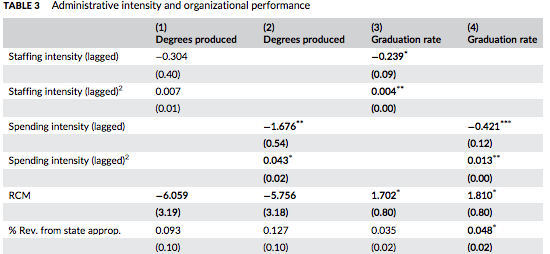
The authors further investigate an association between administrative intensity and student outcomes. Though, Darnley et al. argue that this is secondary in their study, for public universities student outcomes are critical. Their empirical results show that spending intensity is significantly related to degrees produced and student graduation rates. A snapshot from Table 3 contains these findings.

Trends in Public Support for a Federal Balanced Budget Amendment

Forthcoming in Public Budgeting & Finance is a paper by Andrew Crosby (Pace University) and Allyson Holbrook (University of Illinois-Chicago) titled “Public Support for a Balanced Budget Amendment to the U.S. Constitution: Trends and Predictors.” Here is the abstract:

Although researchers have explored policy attitudes in domains that require expertise (e.g., medicine), less research has explored policy attitudes related to economic policies that also require expertise to understand. This paper examines public opinion about a balanced budget amendment (BBA) to the U.S. Constitution. Using data from 38 national public opinion polls conducted over 36 years, we find that support for a BBA is related to respondent and contextual factors. Support for a BBA has become more polarized along party and ideological lines over time, and implications of a BBA for other policies affect people’s support for an amendment.

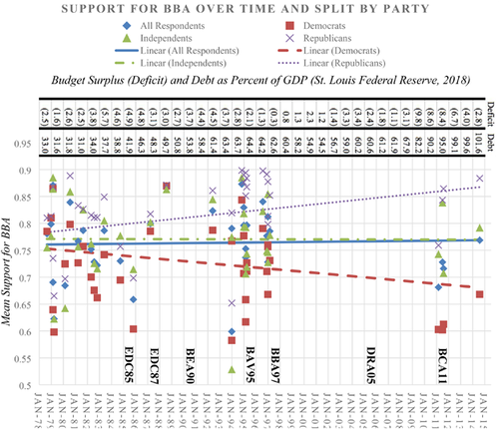
Crosby and Holbrook provide some determinants in a series of logit regressions, but I think the trends of the raw data are most interesting. Over time, they find that support for a BBA has generally been flat (even though the polls and survey methodology change over time), but high at around 76%. Interestingly, democrats have slightly reduced their support while republicans have increased, here is their Figure 1:

BBA

Public support is high here despite the fact that public finance scholars and economists are generally unfavorable toward such a policy. What is particularly interesting is that support is so high (and basically bi-partisan) yet we do not have such a policy. Amending constitutions are difficult, and perhaps if it was on the table support would go down as it became a subject they learned more about (making them more like economists). Another possibility is that parties avoid the topic. In Bryan Caplan’s Myth of the Rational Voter, heposits that politicians try hard to give voters what they want, but voters often want contradictory things. Here you could imagine an politician looking at BBA and reasoning “my voters want a BBA, but they also like being employed, and economists tell me these two are likely to be in conflict with one another; so long as voters don’t punish me too much for ignoring the BBA request I will protect their employment.”


Evidence on Local Political Budget Cycles from Tax Centralization

Available online at International Tax & Public Finance is “Switch toward tax centralization in Italy: a wake-up for the local political budget cycle” by Massimiliano Ferraresi, Umberto Galmarini, Leonzio Rizzo, and Alberto Zanardi. Here is the abstract:

Are the incentives to expand expenditure before local elections affected by the composition of local governments’ revenues? We explore this issue by exploiting the Italian government bill that in 2008 replaced the municipal tax on main residence with a vertical transfer. Relying on staggered dates of municipal elections to identify the effect of the reform, we find evidence of a political budget cycle, but only for municipalities that in 2008 were in their pre-electoral year. The result suggests that a lower degree of municipal tax autonomy strengthens the incentives to expand the size of the budget before the elections.

You get a sense of the identification strategy from the abstract, but it seems worth noting that the paper finds support for political budget cycle in the broadest terms — that the revenues and expenditures are correlated with election cycles — than any specific political budget cycle theory. In particular, they find that after centralization both current expenditures and revenues from charges/fees increased by equivalent amounts. Under some theories of political budget cycles, governments become more deficit prone as they cut taxes and increase spending just prior to the election cycle to protect incumbents, but that isn’t obviously occurring here. The authors seem to think it is a relative change in the political price for own source revenues that translates into spending:

Our interpretation of the result is that the primary channel through which the reform prompted incentives for expanding the budget in pre-electoral years was by lowering the costs for financing expenditure increases with own revenue sources. Before the 2008 reform, the three main sources of own revenues of Italian municipalities were the property tax on main residence, whose burden is entirely borne by residents who are also voters at the local level, users’ fees and charges, whose burden is mostly borne by residents directly benefiting from municipal services, and the property tax on additional residence, whose burden is in some cases mostly borne by non-residents, as in municipalities located in touristic areas. Since taxing the main residence is highly unpopular, before 2008 most municipalities applied tax rates on main residence just above the minimum level imposed by the central government, while they exerted more effort in the taxation of additional residences and in the determination of fees and charges, though the room to rely heavily on the latter was narrow, since residents were already taxed on main residence. Under these conditions, local administrators had little capacity of making leverage on own revenues to finance expenditure expansions for electoral purposes. The 2008 reform changed the setting. By relieving local administrators from having to impose a burden on residents on their main property, and by substituting the revenue loss with a compensating transfer, the reform considerably reduced the political costs incurred by local administrators to make leverage on user fees and charges to finance pre-electoral expenditure hikes.

I’ve previously blogged recent research on PBCT in the post Research on Overlapping Political Budget Cycles.

New Issue of Public Finance Review

The March 2019 issue of Public Finance Review has been published:

Integrating Microsimulation Models of Tax Policy into a DGE Macroeconomic Model
Jason DeBacker, Richard W. Evans, and Kerk L. Phillips


Relative Tax Rates, Proximity, and Cigarette Tax Noncompliance: Evidence from a National Sample of Littered Cigarette Packs
Shu Wang, David Merriman, and Frank Chaloupka
Social Security and Saving: An Update
Sita Slavov, Devon Gorry, Aspen Gorry, and Frank N. Caliendo
Consumption Taxes, Income Taxes, and Revenue Sensitivity: States and the Great Recession
Howard Chernick and Cordelia Reimers
Does Foundation Giving Stimulate or Suppress Private Giving? Evidence from a Panel of Canadian Charities
Iryna Khovrenkov
Impact of Tax and Expenditure Limits on Local Government Use of Tax-supported Debt
Sharon N. Kioko and Pengju Zhang
Equilibria and Location Choice in Corporate Tax Regimes
Ben J. Niu

For Teaching Notes: Political Rhetoric

I teach public budgeting & finance as part of the core in our MPA program. Budgets are a managerial tool, but also a exercise in persuasion. Justifications are required on the terms of the decision makers, not your own. For that reason, I did a segment on political rhetoric (slides annotated with comments downloadable here) with an emphasis on three topics:

  1. Traps in Talking Past One-Another
  2. Logical Fallacies
  3. Diagramming Arguments

I like to imagine these help contribute to a more civil and higher quality discourse. Feel free to make use of the slides (would appreciate knowing if you do), and I would welcome any feedback. A little about each topic…

Traps in Talking Past One-Another

If you and your counter party cannot understand each other you won’t get very far in persuasion. Furthermore, if you have at least a working understanding of the ideology you are dealing with (not their caricature), you can choose the more favorable frames and better anticipate their questions. I had the students read Arnold Kling’s Three Languages of Politics, which is $4 at Amazon or free at Cato, so in lecture we went through a news article on privatized firefighting in California.

Discussions of what constitutes a “Right” is another pitfall, so I provided the positive and negative right dichotomy, which is another good working conceptualization of rights provided you don’t overthink it.

Lastly, I discussed anecdotes. Anecdotes are perhaps the lowest status form of evidence, which is interesting in part because as a professor (a high status position in the world of evidence dispensaries) I use anecdotes all the time to teach. I think the problem is one of conflating the use of anecdotes to make a logical point versus a statistical one. I think gun control and border immigration control are good examples where groups talk past one another (perhaps deliberately) by differences in the intention of their anecdotes.

Logical Fallacies

There are hundreds of fallacies, but I went with ones I felt were most common in public economics debates:

  • Genetic Fallacy
  • Sunk Cost Fallacy
  • Ecological Fallacy
  • Fallacy of Composition
  • False Analogy
  • Ad hominem
  • Motte and Bailey Tactic
  • False Indicator Fallacy (Ok, I made this one up, it probably is already nested in another fallacy)
  • Appeal to Tradition
  • Post hoc ergo propter hoc
  • Politician’s Syllogism
  • Argument from Ignorance
  • Fallacy Fallacy

Diagramming Arguments

We finished with a overview on how to diagram an argument. Of course this is helpful in preparing your own argument and in critiquing others. I distributed the recent NYT op-ed by Saez and Zucman and had them try their hand at it before showing them a rough sketch of my own.