New Issue of Public Budgeting & Finance

The Fall 2018 issue of Public Budgeting & Finance is now available. Here is the Table of Contents:

Fiscal Institutional Externalities: The Negative Effects of Local Tax and Expenditure Limits on Municipal Budgetary Solvency.” Benedict S. Jimenez.

Use of Special Assessments by Municipal Governments in the Chicago Metropolitan Area: Is Leviathan Tamed?” Rebecca Hendrick & Shu Wang.

Budget Reforms in Times of Austerity: A Centralization Cascade in Danish Central Government?” Mads Bøge Kristiansen

Why Are We Lagging Behind? An Empirical Analysis of Municipal Capital Spending in the United States.” Wen Wang & Yonghong Wu

Book Review: Government Budgeting and Expenditure Management: Principles and International Practice, by Salvatore Schiavo‐Campo. New York, NY: Routledge,2017.” Vito Tanzi

Labor Day 2018: Tax Incidence and Unions

If not an outright monopoly of labor, unions are at least a form of imperfect competition in the labor market. Theories of tax incidences are much more varied are hard to generalize as competition diminishes. Consider a monopolist with a linear demand curve, then the monopolist will bear 1/2 the economic incidence.(a) However, the monopolist will be able to overshift onto output consumers if the demand curve lends itself to optimal mark-up rules, as in the case of a constant elasticity demand function.(b) In an oligopoly market, there is no widely accepted theory of firm behavior and therefore no generalizations of what tax incidence may be (see Stiglitz & Rosengard, Economics of the Public Sector 4th edition, p. 556).

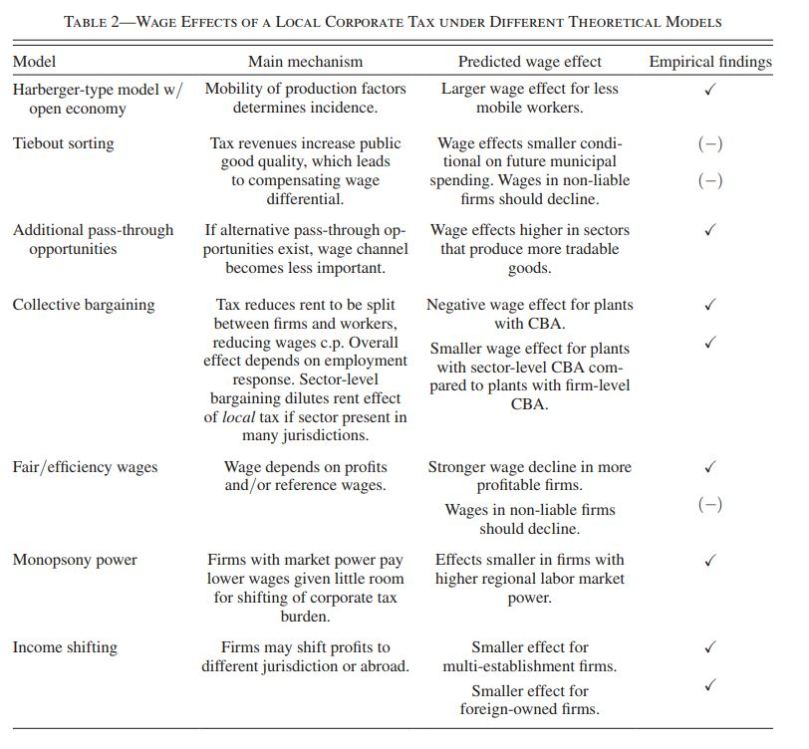
One of the interesting areas of research in recent years has been on the labor incidence of the corporate income tax, and generally it seems unions bear a substantive portion of the tax’s burden. In this NBER Paper by Felix and Hines (“Corporate Taxes and Union Wages in the United States”, 2009) find that unions capture about half of the gains of reductions in state corporate income taxes. Similarly, a recent American Economic Review article by Fuest, Peichl, and Siegloch uses a rich employer-employee linked administrative dataset from Germany and finds worker wages absorb about half the burden of the corporate income tax, but that there is considerable heterogeneity across a whole variety of wage-setting institutions in the country. The findings are difficult to summarize, but they helpfully provide this Table where their last column summarizes their corresponding empirical findings:

Tab2Fuest

Notes:

(a) This one-half result falls out of the linear demand function of the form p=A-bq yields a total revenue function of p*q=Aq-bq^2. Taking the derivative yields a marginal revenue curve of MR=A-2q.

(b) In a CES demand function, the optimal mark-up rule yields p=[(e)/(e-1)]*MC, where e is the price elasticity of demand in absolute value. The function is defined when e>1, so if e=2 then price is double marginal cost [2/(2-1)=2]. Adding a tax to marginal cost would cause the change in price to be a multiplier increase based on that mark-up, resulting in overshifting.

PB&F Virtual Roundtable on Retail Sales Tax

Next week Public Budgeting and Finance is hosting its second Virtual Roundtable, this time on the Retail Sales Tax.

Moderating the discussion is Whitney Afonso (UNC-Chapel Hill), who has published numerous papers on sales taxes, including this 2015 winner of the Jesse Burkhead Award for the year’s best article in PB&F.

Panelists include: Cynthia Rogers (University of Oklahoma) who has done some extremely influential work on horizontal and vertical tax competition in sales taxes; Don Bruce (University of Tennessee-Knoxville) who is an expert on state taxation generally but was also among the first scholars to work on e-commerce and sales taxation in the early 2000’s; and Barry Boardman, a longtime professional economist in the public sector who is currently the Chief Economist of the North Carolina General Assembly.

Date: Thursday, September 6, 2018
Time: 1PM EST
To Join: 

Call for Papers: Taxation in the Digital Economy

The CESifo Group in Munich is hosting a 2019 summer conference in Italy on the subject. Here is the website, below are the specs:

Venice Summer Institute 2019: Taxation in the Digital Economy: Theory and Evidence

Time: Jun 3, 2019 9 AM – Jun 4, 2019 2 PM

Address: San Servolo, Venice, Italy

Recent technological changes challenge fiscal systems. For instance, the internet allows consumers to shift purchases from physical firms to online retailers, which possibly results in the creation of digital products that have no “physical” component. At the same time, internet platforms use different business models compared to standard ones. Digital platforms like Netflix and Google connect different groups of customers and thereby use pricing strategies for their products that reflect how desirable one group is for the other groups. The multi-sidedness of the platform and the global outreach of the platforms might lead to unconventional incidence and efficiency effects of taxes. These technological changes have important policy implications. For example, the issue of how value creation by digital platforms might be allocated to the various jurisdictions for corporate taxation purposes is currently the subject of hotly debated reforms proposed by the European Commission. Taxation of online sales is the subject of U.S. federal legislation such as the Marketplace Fairness Act and recent Supreme Court action. The workshop aims to combine theoretical research and empirical evidence of taxation in the digital economy. The goal is to facilitate interactions between researchers focused on industrial organization, i.e., responses of prices/firms and public finance economists interested in the effect of the digital economy on fiscal systems.

Keynote speakers: Jean-Charles Rochet, University of Zurich, and Joel Waldfogel, University of Minnesota

Scientific organiser(s): Marko Köthenbürger, David R. Agrawal


Program for the National Tax Association’s Annual Conference

The conference webpage can be seen here. Programs at a glance below. I’m quite pleased to be presenting in the first session on health insurance with no subsequent discussant duties.

THURSDAY, NOVEMBER 15

8:30-10:00 am

Concurrent Sessions

• Behavioral Responses to Taxation
• Debt, Equity, and International Taxation
• Field Experiments in Tax Administration
• Health Insurance: New Evidence from Policy Changes
• Household Saving and Portfolio Behavior
• Policy Innovations in Developing Countries
• Recent Developments in State and Local Public Finance
• Regional Implications of Fiscal/Monetary Stimulus
• Response to Policy
• Tax Administration and Compliance: Regulatory Design

10:00-10:15 am

Coffee Break

10:15-11:45 am

Concurrent Sessions

• As Uncertain As Local Taxes
• Bunching Evidence on Responses to Taxation
• Charity and Public Goods 1
• Consequences of Corporate Tax Reform
• Environmental Taxes, Cross-border effects and Government Interaction
• Fiscal Policy Transmission
• Investment and International Tax Incentives
• Property Taxes and Local Debt
• Shareholder Taxes and the Firm
• The Link Between Secondary and Post-Secondary Education and the Labor Market

12:00-1:30 pm

Luncheon

Keynote Speaker: Michael Devereux, Director of the Oxford University Centre for Business Taxation, Professor of Business Taxation, Saïd Business School, University of Oxford

Presentation of Awards:

  • Outstanding Doctoral Dissertation in Government Finance and Taxation
  • National Tax Journal Referee of the Year Award
  • National Tax Journal Richard Musgrave Prize
1:45-3:15 pm

Concurrent Sessions

• Corporate Innovation and Start-Ups
• Digital Aspects of International Tax
• Income Mobility and Expectations
• Information, Engagement, and Compliance
• Investment in K-12 Education
• Measurement of Tax Planning, Tax Planning and Uncertainty
• Optimal Tax 1
• Pension Policy and Saving
• Responses to Local Taxation
• Responses to Personal Taxation
• Tax Design: Withholding, User Fees, and Consumption Taxes

3:15-3:45 pm

Coffee Break

3:45-5:15 pm

Concurrent Sessions

• Capital and Labor
• Charity and Public Goods 2
• Corporate Taxes and Aggregate Investment
• Health Policy 2
• International Tax Competition
• Labor Supply and Tax Rates
• Local Public Finance Abroad
• Optimal Tax 2
• Tax Administration Issues Affecting Low Income Taxpayers
• Taxes on Consumption in Developing Countries
• Topics in Political Economy

5:15-6:15 pm

Annual Meeting of the National Tax Association

6:15 – 7:30 pm

Thursday Night Reception

FRIDAY, NOVEMBER 16

7:15-8:15 am

Graduate Student Breakfast

8:30-10:00 am

Concurrent Sessions

• Financial Reporting and Auditing
• Health Policy
• Misreporting and Tax Compliance in Developing Countries
• Natural Experiments and Demographic Variation in Compliance
• Optimal Tax 3
• Policy Impacts on Retirement
• Politics and Policy Outcomes
• Profit Shifting After Territorial
• State and Local Tax Workarounds
• Using Experiments to Inform Tax Policy
• Wayfair: The Way Forward

10:00-10:15 am

Coffee Break

10:15-11:45 pm

General Session

Fiscal Policy after the Midterm Elections

Moderator: William Gale, Brookings Institution

Panelists:  Michael Graetz (Columbia Law School);  James R. Hines Jr. (University of Michigan);  Mark Prater (PricewaterhouseCoopers);  Kim Rueben (Urban-Brookings Tax Policy Center); Betsey Stevenson (University of Michigan)

12:00-1:30 pm

Luncheon

Keynote: Hilary Hoynes, Professor of Economics and Public Policy, University of California Berkeley

Presentation of Steven D. Gold Award

1:45-3:15 pm

Concurrent Sessions

• Compliance, Enforcement, and Dynamic Responses
• Infrastructure and Local Debt
• Legal Perspectives on the TCJA
• M&A and Supply Chain
• Optimal Tax 4
• Rethinking the Value of Public Policy
• Safety Net Programs and Labor Markets
• Student Loans and Repayment
• Taxation, Public Goods and Externalities
• The 2017 Tax Bill and the Future of Tax Reform

3:15-3:45 pm

Coffee Break

3:45-5:15 pm

General Session

Plenary Panel: In honor of Michael Keen, 2018 Holland Award Recipient

Session Chair: Victoria Perry, International Monetary Fund

Panelists: Michael Devereux (Oxford University);  Li Liu (International Monetary Fund);  Joel Slemrod (University of Michigan);  Ruud De Mooij (International Monetary Fund)

5:15-6:15 pm Graduate Student Poster Session
5:15-6:30 pm

Friday Night Reception in honor of Holland and Steve Gold Award Recipients

SATURDAY, NOVEMBER 17

8:30-10:00 am

Concurrent Sessions

• Agency Conflicts
• Behavioral Biases and Corrective Taxation
• Benefit Take-Up
• Distributional Analysis After the 2017 Tax Act: Findings and Directions for Research
• Fiscal Policy and the Labor Market
• Local Expenditures
• Optimal Tax 5
• Saving Responses to Pension Design
• TCJA and Related
• Transparency and Tax Avoidance

10:00-10:15 am

Coffee Break

10:15-11:45 am

Concurrent Sessions

• Earnings and the Firm-Employee Relationship
• Financial Reporting II
• Housing, Commercial Property and Local Taxes
• Inequality and Taxation
• New Empirical Perspectives on the Aggregate Effects of Fiscal Policy
• On Tax Havens
• Post-secondary Education Access and Returns
• Specific Provisions
• Tax Preparers and Tax Administration
• Taxation with Non-standard Utility Functions

12:00 pm

Lunch
(Attendee’s choice — Conference does not provide lunch)

1:00-2:30 pm

Short Course: New Research on Business Taxation

Presenter: Eric Zwick, Associate Professor of Finance, University of Chicago Booth School of Business
Sponsored by the University of Michigan Office of Tax Policy Research

Research on Special Districts and the Fiscal Commons

For local governments, a polycentric system is one where you have multiple, partially overlapping types of local governments. The communities which through government jointly produce the waste services may be different from those which provide the schools or fire protection. There is good reason for this a priori, as there may be differences in preferences for these services or the cost of provision may be different. What makes sense as boundaries for a school district might not align with what works for a network of sewer systems. On the other hand, you can imagine goal conflicts and coordination problems occurring that result in unnecessary expenses (e.g. my city just repainted a road only to see the sewer utility rip it up the next day for some maintenance). These trade-offs were discussed extensively in this famous 1961 paper on metropolitan areas by Vincent Ostrom, Charles Tiebout, and Robert Warren. Polycentric governance is more generally discussed as an important adaptive management system for resolving commons property problems featured in Elinor Ostrom’s Nobel prize winning research.

Via Rob Greer (Texas A&M), Tima Moldogaziev (University of Georgia), and Tyler Scott (UC-Davis) in the International Journal of the Commons comes “Polycentric Governance and the Impact of Special Districts on Fiscal Commons.” Let’s start with the abstract:

Local government services are increasingly being provided in fragmented polycentric systems where the overlapping jurisdictions draw resources from the same fiscal base. Developing optimal policies for the efficient management of fiscal resources requires a consideration of the total underlying fiscal pool. In this study, we evaluate the impact that special purpose districts have on debt ratios at the county “common pool” level in the State of Georgia (U.S.) between 2005-2014. Empirical findings suggest that inclusion of all general government and special purpose debt for each county may at times result in a greater burden on fiscal common pool than existing rules permit. These results call into question the efficacy of fiscal policies in a polycentric governance system that neglect to account for debt levels for all actors within the confines of a single fiscal common pool unit. Results also show that total debt ratios are significantly affected by special districts that operate within boundaries of a single county. We find no evidence that independent special districts have a differential impact on fiscal common pools compared to their dependent counterparts. 

So, the classic Tragedy of the Commons framework for setting up an empirical test is that you have some kind of production function from a resource input, like fish production from a lake. A monopolist will fish sustainability to maximize the long-run productive value of the lake, but add a competitor and you get diminished long-run production (albeit, perhaps increased short-run) because neither is promised that they have rights to the future stock. Now maybe the two can come together to coordinate and cooperate to avoid this, but the coordination problem becomes increasingly difficult as the number of competitors increase. You get continuously increasing costs from effort to extract diminishing product.

In taxation, the logic of the commons is somewhat similar. Increasing the number of stakeholders with access to the same economic base will cause each individual unit to exert additional “tax effort” that jointly produce lower tax revenues than a singular monopoly government (e.g. See Figure 2 in this 1997 Russ Sobel paper).

Greer and colleagues extend a similar argument, pointing out that many of these forces can affect the amount of public debt (see their Section 3):

  • Debt represents the borrowing of future revenues, but the ability to make a unique claim to these future revenues are less credible as you increase the number of overlapping local governments.
  • Multiple overlapping governments will face revenue shortfalls because of the previously mentioned taxing problems, and thus will turn to debt.
  • Special district formation in an area is often done to take on new debt, sometimes to circumvent state restrictions.
  • More decentralized systems increase the set of specialized public goods, which increases demand (and debt to back) public services.

For all these reasons, Greer and colleagues say, you could expect increases in debt measures with the number of special districts (special districts being the source of within-county variation in the number of overlapping local governments). On page 18, they provide a plot of their credibility intervals (Bayesian confidence intervals). The mean of the interval suggests that adding a special district increases the total debt to assessed value ratio by 0.20 percentage points, which is about 7 percent of the mean debt observed. If you assume linearity in this effect, the median Georgia county with 6 special districts could cut their overall debt by about one-third if they consolidated to a single special district. The research design cannot tell us much about whether this would be welfare increasing or not because it does not discriminate among the potential mechanisms. But the findings lend credence to the idea that these concerns are worth further investigation because special district formation does seem to be changing the fiscal landscape.

See Also:

Raudla, Ringa. (2010). “Governing the Budgetary Commons: What Can We Learn from Elinor Ostrom?European Journal of Law & Economics.


Friday Research Round Up

Some recent research that has otherwise gone unmentioned here:

“Pension Taxes and Labor Supply: Evidence from a Historical Quasi-Experiment.” Olga Malkova. SSRN Working Paper.

“Information, Tax Salience, and Support for School Bond Referenda.” By Eric Brunner, Mark Robbins, and Bill Simonsen. Public Budgeting & Finance.

House Prices and Property Tax Revenues During the Boom and Bust: Evidence from Small-Area Estimates.” By Chris Goodman. Growth & Change.

“The Fiscal Disparity and Achievement Gap Between Extremely Wealthy and Poor School Districts in Illinois.” By Mary D. Bruce, Natalia Ermasova, and Linda Mattox. Public Organization Review.

“Inter-municipal Cooperation and Local Taxation.” Marie-Laure Breuille, Pascale Duran-Vigneron, and Anne-Laure Samson. Journal of Urban Economics.

“Partial Fiscal Decentralization Reforms and Educational Outcomes: A Difference-in-Difference Analysis for Spain.” Paula Salinas and Albert Sole-Olle. Journal of Urban Economics.

“Inclusive Fiscal Reform: Ensuring Fairness and Transparency in the International Tax System.” By David Bradbury and Pierce O’Reilly. International Tax & Public Finance.

“Do Sanctions Improve Compliance with Public Finance Laws and Regulations?” Richard Allen and Yugo Koshima. Public Budgeting & Finance

“Tax Compliance and Enforcement.” By Joel Slemrod. NBER Working Paper.

“Behavioral Public Economics.” By B. Douglas Bernheim and Dmitry Taubinsky. NBER Working Paper.

“Redistributing the Gains from Trade Through Progressive Taxation.” By Spencer Lyon and Michael Waugh. NBER Working Paper.

“Unintended Consequences of Eliminating Tax Havens.” By Juan Carlos Suarez Serrato. NBER Working Paper.

Does Federal Contracting Spur Development?

That is the question in a new paper forthcoming in the Journal of Urban Economics by Andres Rodriguez-Pose (London School of Economics) and Michiel Gerritse (University of Groningen), and the full title is “Does Federal Contracting Spur Development? Federal Contracts, Income, Output, and Jobs in US Cities.” Here is the abstract:

Firms and governments alike frequently court federal government contracts to generate more jobs and trigger economic growth. However, the employment and output impact of government contracts remains controversial. We use georeferenced data on United States (US) federal contracts, distinguishing between the location of the recipient and the location of the activity, for the years 2005-2014 in order to assess the employment and output impacts of federal contracting in metropolitan areas of the US. We resort to a shift-share instrument and precise location-specific fixed effects to estimate the causal impact of spending. Cities that receive more contract expenditure witness an expansion in output – with contracts generating $1.4 per dollar spent – but experience only modest increases in employment. The impact is also constrained geographically and short-lived. The results suggest that, on average, the effects of federal contracting on local economies are modest, meaning that attracting federal contracts may not be an effective urban development strategy.

For those reading carefully at home, the abstract is describing a Bartik instrument, and yes, it considers advice from Goldsmith-Pinkham et al. (2018) and shows that it results in a weak instrument problem that they are able to improve upon through a principal component analysis. Check out Appendix B for more.

To think about this question more theoretically, the not-famous 1956 Charles Tiebout JPE paper is highly readable, and you can see it attempt to establish a theoretically sound bridge between city planners and economic researchers.

“Introduction to Welfare Economics”: Blending the Italian School of Public Finance with Pareto and Wicksell

That is new in Public Choice’s online first bin, written by Francesco Forte in 1961, and I’m just going to have to share the abstract on this:

This is a revised version of Francesco Forte’s introductory lecture on welfare economics delivered in Charlottesville when he first arrived at the University of Virginia. It was then reproduced in the author’s mimeographed book “Introduction to welfare economics”, published by the Thomas Jefferson Center of the University of Virginia in 1961. In the “old welfare economics”, three fundamental approaches may be distinguished. Pareto’s “ophelimity” requires that someone is made better off and no one is made worse off. A similar problem is present both in Wicksell, by the rule of the unanimous consent of the electorate representative, and in the Italian School of Public Finance that requires an open competition aimed at assembling a majority that pursues a similar solution. Finally, Pigou’s paternalistic approach combines maximum national income with its optimal distribution. In the “new welfare economics”, the approach in terms of Pareto’s compensation principle does not generate a stable equilibrium; the social welfare function approach formalizes Pigou’s approach with the inclusion of paternalistic value judgements. The way out consists in combining Paretian ordinal choice with Wicksellian unanimity, with the Italian school’s suggestion of competition in collective choices, or with both.


Does Shaming Work? Tax Enforcement Edition

There is a lot of public conversation about the appropriate use of shaming in civil society. Where the law fails to punish offenders, advocates say, shaming can be productive for punishment and future deterrence. Detractors worry that unregulated mob justice is not justice at all and that it has a quieting effect on genuine civil discourse where honest disagreement can occur. When shame is appropriate and how to generate good social norms is an ongoing question.

Shaming is also a public policy tool wielded by the government for purposes like encouraging energy conservation and extending the punishment of sex offenders. In tax policy, governments of every level around the world have experimented with the use of shaming to encourage enforcing tax payments. One difficulty with shaming is trying to distinguish it from other salience effects (i.e. reminding people they could be audited or are delinquent) that is unique from shaming. An excellent piece of research on the role of shaming in tax enforcement comes from Ricardo Perez-Truglia and Ugo Troiano (NBER, August 2018). Here is the abstract:

Many federal and local governments rely on shaming penalties to achieve policy goals, but little is known about how shaming works. Such penalties may be ineffective, or even backfire by crowding out intrinsic motivation. In this paper, we study shaming in the context of the collection of tax delinquencies. We sent letters to 34,334 tax delinquents who owed a total of half a billion dollars in three U.S. states. We randomized some of the information contained in the letter to vary the salience of financial penalties, shaming penalties, and peer comparisons. We then measured the effects of this information on subsequent payment rates, and found that increasing the visibility of delinquency status increases compliance by individuals who have debts below $2,500, but has no significant effect on individuals with larger debt amounts. Financial reminders have a positive effect on payment rates independent of the size of the debt, while information about the delinquency of neighbors has no effect on payment rates.

A bit more specifically, the researchers randomly sorted subjects into two treatment groups, group one represented zip codes from which one person would be selected, while in group two the researchers would also select additional areas from the same area to inform them about an online list of delinquents. Within these groups they randomize the salience of other information, in addition to notice that their “neighbors” were able to find them on the shaming list. The first treatment group ferreted out the salience or notice of being watched by the government, while the second added a peer component for the prospect of social pressure.

There is a lot of cross-randomization in this, so there is a rich array of findings, including some that allow them to arguably distinguish whether it was peer pressure via shaming or whether it allowed them to acclimate and contextualize their tax debt in a social context.  In the end, as the abstract says, the shaming seems to have worked for lower tax debts. Pages 5 and 6 walk neatly through the results with interpretation and qualifications.