“What Are the Determinants of Public Spending? An Overview of the Literature”

That is the title of a new paper by Francois Facchini (University of Paris) forthcoming in the Atlantic Economic Journal. The argument of the paper is that econometrics is not going to ultimately explain (at least on its own) the size of the public sector, but it also contains a useful summary on the history of thought. Here is the abstract:

The purpose of this paper is to present and assess the literature about the determinants of public spending. Its originality is the adoption of a methodological perspective. Does econometrics allow economists to discover universal constants for public spending or is it only another way of writing the history of public finance? The economic theory of the size of government includes 23 explanations and 78 explanatory variables. The size of government reflects the preferences of citizens (demand model), the power of politicians and bureaucrats to impose their interests against citizens’ interests (supply model) and the constitutional design that governments face in raising revenue. Nonetheless, the great instability of econometric tests shows, all the difficulties of the science of public finance in finding a constant and discovering real causality between these variables. The analytical consequence of this result is the great futility of the search for a general law of the dynamic of public spending. This futility can be interpreted as a consequence of the complexity of political exchange. The size of the state is a multi-causal phenomenon. The prescriptive consequence is that it is not possible to use quantitative analysis to defend a form of “causal manipulationism” and predict the timing of state reforms and a political strategy to reduce the share of public spending in production. Econometrics is only one way of reporting the history of public finances.

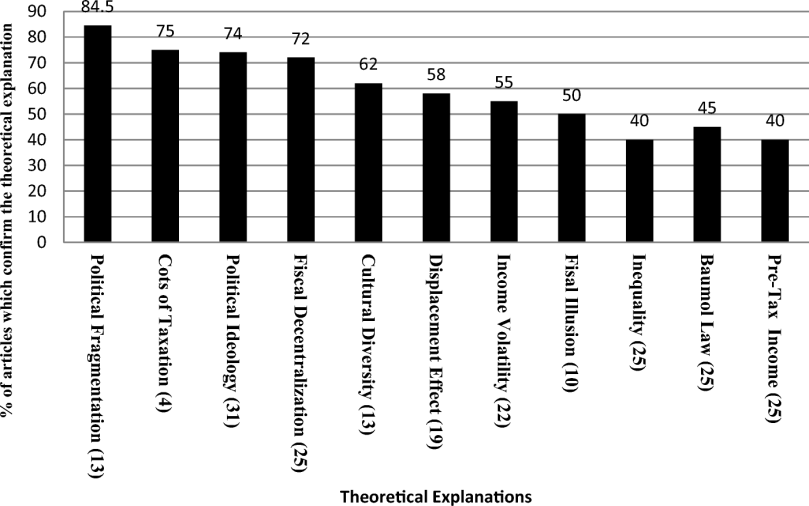
This figure is also quite interesting, it shows concepts studied, the number of studies that confront them, and how frequently they seem to conform to theoretical expectations. Political fragmentation is the most commonly accepted hypothesis at 84%, while the base size of the economy as measured by pre-tax income has been the least likely to conform to expectations (40%):

11293_2018_9603_fig3_html

Regulation and Government Debt

New in Public Choice by Niclas Berggren and Christian Bjørnskov is evidence that more regulation in the market economy results in higher levels of public debt.

Government debt is large in most developed countries, and while budget deficits may reflect short-term attempts to kick-start the economy in times of crisis by means of fiscal stimulus, the longer-term consequences may be detrimental to investment and growth. Those negative consequences make it important to identify factors that are associated with public debt. While previous studies have related government debt to economic and political variables, they have not incorporated the degree to which the economy is regulated. Using a measure of regulatory freedom (absence of detailed regulation of labor, business and credit) from the Economic Freedom of the World index, we conduct an empirical analysis covering up to 67 countries during the period 1975–2010. The main finding is that regulatory freedom, especially with respect to credit availability, reduces debt accumulation. The effect is more pronounced when the political system is fractionalized and characterized by strong veto players, indicating policy stability and credibility, and when governments have right-wing ideologies.

This wasn’t very intuitive to me, so I’ll unpack the authors arguments a little bit here. By “debt accumulation,” the authors mean public debt as a percent of GDP (as opposed to per capita debt or total debt). I’m not crazy about that, as regulation plausibly affects GDP, but I’m not sure what a better way to scale it would be. Here is a preview of the theoretical explanation:

We propose that the extent to which an economy is regulated matters, on the basis of four theoretical links. The first is that people who hold pro-market attitudes tend to be opposed to public regulation of the private sector and hold skeptical views about substantial government debt. The second and third are that regulation affects the functioning of the economy in ways that influence debt, and that regulation may serve as a signal to lenders regarding contemporaneous or future problems in the economy or the government, such that they set interest rates (that influence debt levels) accordingly. Finally, a regulated economy may be comparatively inflexible and unable to adjust very well to changing macroeconomic circumstances, which could leave the government with incurring debt to counteract downturns as its only politically viable option.

The first link is probably true, but isn’t all that interesting as it is arguing that regulation is correlated with an omitted preference for government rather than being a causal factor in its own right. The other links are indirect in the sense that the regulation causes something else to happen and that something else also affects debt. This is usually the stuff that leads to structural modeling but that is not where this paper is going.

The last theoretical link is the most interesting I think, where the supply of regulation creates demand for additional government spending during recessions. My first thought was that more volatile economies (induced by regulation or not) should plausibly have governments more engaged with countercyclical policies that enable consumption smoothing. That should plausibly cause more short-term debt during downturns, but also greater rainy day fund balances (albeit it is not empirically obvious in looking at the American states).  However, the authors proposed mechanism for this link is a kind of political commitment where heavy regulation means the government is now more responsible for a well-functioning economy. Kind of a “you break it you bought it” style of commitment.  I’m not sure I believe that specific mechanism, but it does make some intuitive sense to me that a more regulated private economy that restricts access to private credit or slows down private capital reallocation will increase the government’s comparative advantage in borrowing over private citizens. That is, the larger the Okun Gap, the greater the gap in borrowing costs between the private and public sectors that might plausibly favor government-over-private borrowing.

The regression results hold up the association (see the last variable, “Regulatory freedom”) that less regulation implies less public debt, though the point estimate will halve or double as you start adding control variables, so we are a long way from a convincing causal estimate.
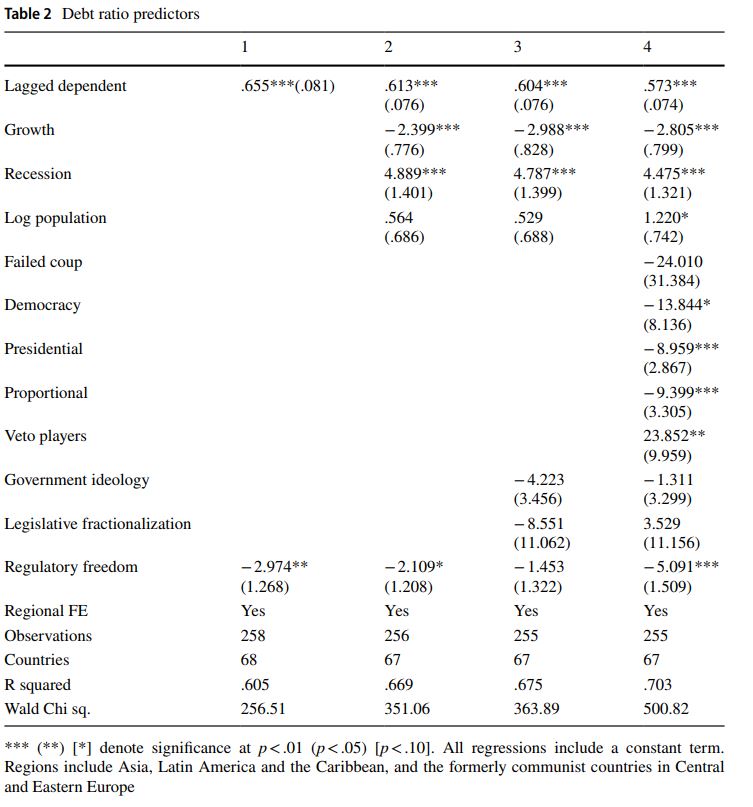
DebtRatio

Still, it is an interesting hypothesized mechanism, and it would be interesting to see if it would bear out in a cleverly designed citizen or policy maker experiment of some type.
 

Informal Norms in the Federal Budget Process

Confronted with the threat of another impending federal government shut-down over the budget, much has been made of recent trends in the dissolution of norms in both politics and civility.

For a longer run perspective on the role of norms, I thought it useful to visit an interesting paper (ungated) in the Journal of Institutional Economics by Peter Calcagno (College of Charleston) and Edward Lopez (Western Carolina University) on the role of informal norms in the federal budget process. The argument is in the title with “Informal Norms Trump Formal Constraints: The Evolution of Fiscal Policy Institutions in the United States.” Here is the abstract:

Two shifts of informal rules occurred in the decades around the turn of the 20th century that continue to shape U.S. fiscal policy outcomes. Spending norms in the electorate shifted to expand the scope of the government budget to promote economic security and macroeconomic stability. Simultaneously, norms for elected office shifted to careerism. Both norms were later codified into formal rules as legislation creating entitlement programs, macroeconomic responsibility, and organizational changes to the fiscal policy process. This institutional evolution increased demand for federal expenditures while creating budgetary commons, thus imparting strong motivations to spend through deficit finance in normal times. Despite the last four decades of legislative attempts to constrain spending relative to taxes, the informal norms have trumped the formal constraints. While the empirical literature on deficits has examined the constraining effects of informal rules, this paper offers a novel treatment of shifting norms as having expansionary effects on deficits.

Here is some more:

Our historical investigation traces today’s U.S. fiscal policy challenges to two shifts of fiscal norms from about 1880 to 1930. First, there emerged new demands on federal spending to support economic security at the household level and economic stability at the macro level. Second, the industrial organization of supplying federal spending became professionalized and competitive, as elected office transformed from a temporary public service to a pursuit of a career ambition. We describe the combination of these two shifts–the demand side spending norm and the supply-side professionalization norm–as the American polity’s shift away from a balanced-budget norm in favor of a deficit-as-policy norm.

See also a recent blog post here on a paper in Public Choice on the influence of formal rules in state constitutions.  It is tempting to see those two as opposing views, but I would be inclined to read it as Calcagno and Lopez arguing that informal rules carry more explanatory power, not that formal rules are irrelevant at the margin.

The Role of Constitutions in Defaulting on State Debt in the 19th Century

John Dove (Troy University) and Andrew Young (Texas Tech) have a new working paper on that subject titled “US State Constitutional Entrenchment and Default in the Nineteenth Century.”

Basically, an “entrenched” constitution is one where “generality and abstraction” are key features that result in a rigid and long living constitutions precisely because they leave out detailed policy directives. An “unentrenched” constitution is the opposite, and consequently uses specificity to limit what agents of government can do, which somewhat necessarily means you have to make the constitution more adaptable to change with the times. As Dove and Young put it (p. 4-5):

A fundamental tradeoff between entrenched and unentrenched models is one of costs associated with agents capturing the rules versus benefits associated with principals having greater use of the rules to constrain agents.

Both of these models have implications for the ability of a government to credibly commit to a goal such as sustainable fiscal policies. On the one hand, the governed may issue political agents directives that fail to constrain their actions in a way that is consistent with the goal. Priors may then need to be updated and new directives issued that may or may not then be effective; and so on. In that case, being able to “micromanage” within an unentrenched constitutional framework may be part of a credible commitment to the goal. On the other hand, “micromanagement” invites time-inconsistency. Without strong and durable rules, political agents can have incentives to renege on commitments to obtain short-run gains for themselves.

So now bring on the story of debt:

In the nineteenth century US, a wave of state-level constitutional changes were associated with major debt crises stemming from the Panic of 1839 and the subsequent US Civil War. The resulting constitutional changes were designed to commit state governments to sustainable fiscal patterns and prevent defaults moving forward. We employ a panel of states from 1841 to 1884 (the years of actual default) to determine whether certain dimensions of constitutional design (entrenchment, specificity, and scope) correlate with the probability of default. We exploit data from the National Bureau of Economic Research (NBER) State Constitutions Database and construct measures of these dimensions following Versteeg and Zackin (2016).

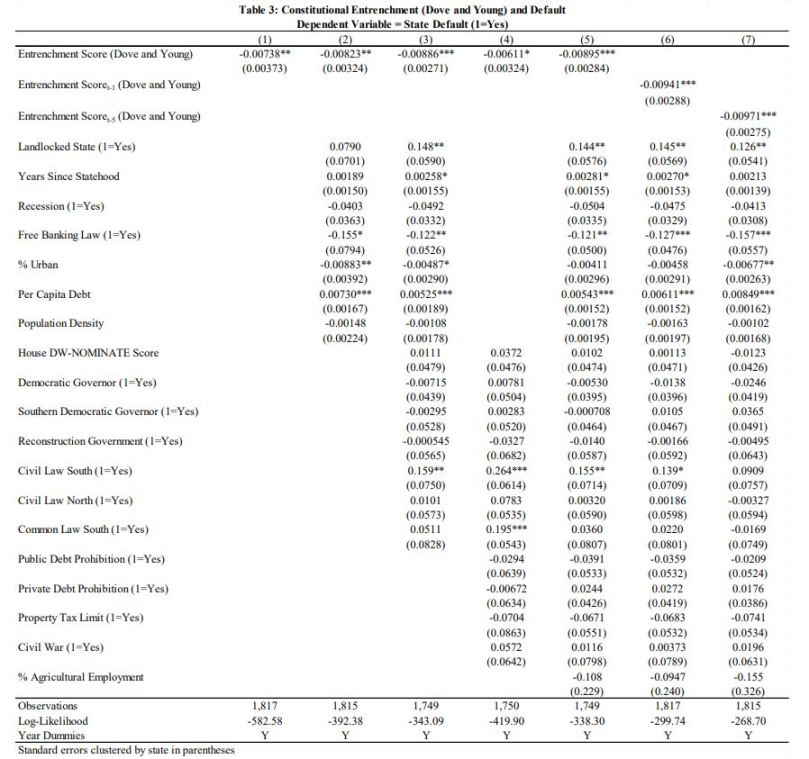
Under their measurement system, they do find states with entrenched constitutions have a lower likelihood of default in a panel-probit regression, and there is not much difference on the variable of interest between their kitchen sink regression and that which only controls for entrenchment (see below). They split out some dimensions of their score into separate categories like “specificity”, “scope”, and “detail” to find that detail and specificity seem to carry the load. The authors infer this to be consistent with the view that constitutional entrenchment arguably increases the credibility of political commitments.

Enchrencment

Workshop on Public Economics

Hosted by the Research Institute for Development, Growth and Economics (RIDGE) is a Workshop on Public Economics to be held in Medellin, Columbia on May 20-21. The submission deadline is February 1. Call for proposals found here, but the topical interests listed in the proposal are:

  • Taxation and Redistributive Systems
  • Optimal Taxation
  • Tax Evasion
  • Welfare Economics and Normative Economics
  • Social Security, Social Insurance and Health Economics
  • Development Economics and Policies
  • Behavioral Economics and Policies
  • Labor Market Analysis/Policies
  • Education and Policies
  • Local Public Economics and Geographical Economics

New Issue of Public Finance Review Available

The January 2019 issue of Public Finance Review is now available online:

Optimal Fiscal Policy in Overlapping Generations Models
Carlos Garriga


Natural Limits of Wealth Inequality and the Effectiveness of Tax Policy
Scott S. Condie, Richard W. Evans, and Kerk L. Phillips


Calculating Value Added of Prostitution with Multiple Data: A New Approach for Belgium
Stef Adriaenssens and Jef Hendrickx


Optimal Government Policies Related to Unemployment
Chia-Hui Lu


Millionaires or Job Creators: What Really Happens to Employment Growth When You Stick It to the Rich?
Ahiteme N. Houndonougbo and Matthew N. Murray


Adjusting State Public School Teacher Salaries for Interstate Comparison
Dan S. Rickman, Hongbo Wang, and John V. Winters


What Are the Financial Implications of Public Quality Disclosure? Evidence from New York City’s Restaurant Food Safety Grading Policy
Rachel Meltzer, Michah W. Rothbart, Amy Ellen Schwartz, Thad Calabrese, Diana Silver, Tod Mijanovich, and Meryle Weinstein

New Issue of National Tax Journal

The December 2018 issue of the National Tax Journal is focused on research relevant to last year’s Tax Cuts and Jobs Act:

A Preliminary Assessment of the Tax Cuts and Jobs Act of 2017 

William Gale, Hilary Gelfond, Aaron Krupkin, Mark J. Mazur, and Eric Toder

Income-Based Effective Tax Rates and Choice-of-Entity Considerations under the 2017 Tax Act 

Bradley T. Borden

Tax Policy and Organizational Form: Assessing the Effects of the Tax Cuts and Jobs Act of 2017

Erin Henry, George A. Plesko, and Steven Utke

Examining S-Corporation Losses and How They Are Used 

Katherine Lim, Elena Patel, and Molly Saunders-Scott

Pass-Through Entity Responses to Preferential Tax Rates: Evidence on Economic Activity and Owner Compensation in Kansas 

Jason DeBacker, Lucas Goodman, Bradley T. Heim, Shanthi P. Ramnath, and Justin M. Ross

The Consequences of the Tax Cut and Jobs Act’s International Provisions: Lessons from Existing Research

Dhammika Dharmapala

The Business Cycle and the Deduction for Foreign Derived Intangible Income: A Historical Perspective 

Tim Dowd and Paul Landefeld

Assessing U.S. Global Tax Competitiveness after Tax Reform

Andrew B. Lyon and William A. McBride

Missing the Mark: Evaluating the New Tax Preferences for Business Income 

Ari Glogower and David Kamin

Mandating Health Insurance Coverage for High-Income Individuals

Paul D. Jacobs


Call for Proposals: IRS SOI Joint Statistical Research Program

The call for proposals is here.

Through its Joint Statistical Research Program (JSRP), the Statistics of Income (SOI) seeks to enable the use of tax microdata by qualified researchers outside the Federal government. Such research can provide new insights and advance the understanding of the ways that existing tax policies affect individuals, businesses, and the economy. It can also provide a new understanding of taxpayer behavior that can aid in the administration of the U.S. tax system. Finally, such research can lead to the development of new datasets useful for future tax administration research, as well as new tabulations that can be released to the public. SOI is a division of the IRS’s Research, Applied Analytics, and Statistics (RAAS) office.

The following subjects are of particular interest to the IRS and the tax research community:
• Tax administration in a global economy
• Taxpayer needs and behavior, particularly the roles of information, complexity, salience, engagement, and compliance costs
• Filing, payment, and reporting compliance measures, behaviors, and drivers
• Taxpayer response to policy changes, particularly taxpayer responses to changes in incentives
• Role of complex business structures in tax planning
• Application of new research methods for tax administration, particularly data science, behavioral insights, or other interdisciplinary approaches

SOI has a strong preference for research projects that generate new datasets and new tabulations that can be replicated and produced on a regular basis. We will accept research proposals for the 2018 JSRP beginning November 12, 2018 and ending December 31, 2018. A panel will evaluate all proposals; evaluations will be based on a number of factors, including the resources available within SOI to support the proposed work. We will announce our final selections by March 29, 2019.

Selected research projects will be performed under formal IRS agreements, which will include a description of the topics and data to be analyzed, term of the projects, regular reporting requirements, and applicable restrictions, including the requirement that SOI review and approve all presentation materials and papers prior to publication or dissemination. Our review is intended to ensure that the product produced is limited to the outlined tax-administration focused objectives, protects confidential IRS processes, and ensures that no individual taxpayer data are disclosed either directly or indirectly based on compliance with IRS published disclosure limitation guidelines. RAAS has a strict policy of neither censoring nor vetoing research findings. All RAAS sponsored research projects are policy neutral. Derivative works produced using publicly released RAAS research papers are not subject to RAAS review.

Working in collaboration with IRS research partners helps ensure accuracy in the interpretation of data items and brings essential domain knowledge to the teams without seeking to promote particular outcomes. SOI staff will participate in all phases of the projects, including research, analysis, and presentation of findings.

Please note that it is unlikely that work on the selected research projects will begin before October 1, 2019. Researchers should plan to complete their research within 2 years from the date they are granted access to the relevant data.

SOI recognizes that the level of data access required by non-IRS researchers may differ across projects based any number of factors. Projects for which a non-IRS researcher will access only aggregated information compiled by the IRS will be conducted under a simple memorandum of understanding. Projects that require a non-IRS researcher to work with statistical microdata will have more substantial contractual arrangements and require U.S. citizenship, a background check, and annual training on IRS data and computer security procedures. Access to tax microdata will occur in an IRS facility using IRS equipment only.

All research projects should result in publishable papers suitable for presentation at a professional conference and for inclusion in the printed proceedings, as appropriate. Your final paper will be made publicly available as a working paper via SOI’s Tax Stats Web page at http://www.irs.gov/statistics. You may also submit your final paper for publication in academic and professional journals.

Trends and Gradients in Top Income Tax Elasticities Across Countries, 1900 to 2014

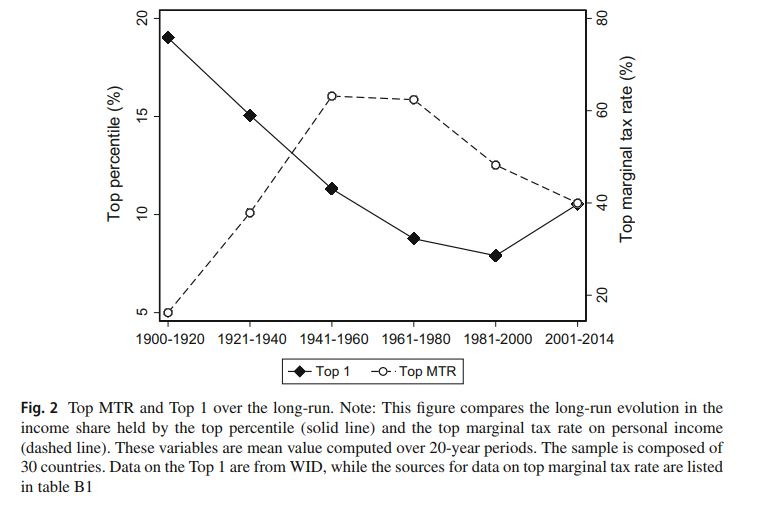
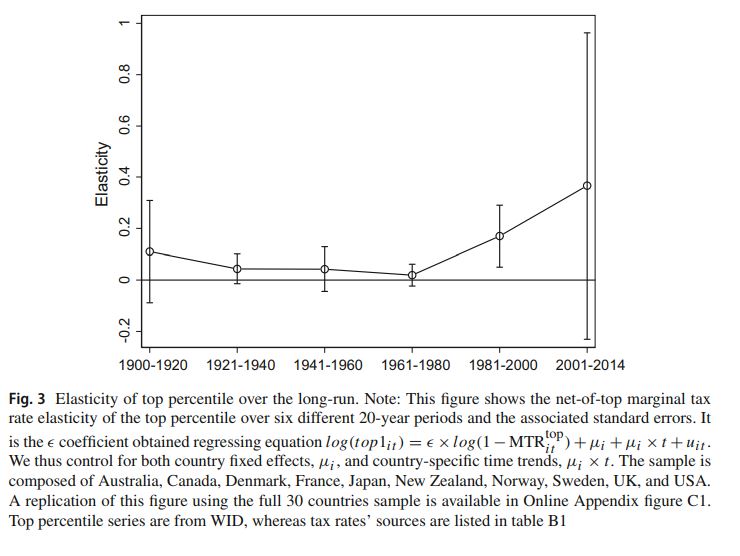
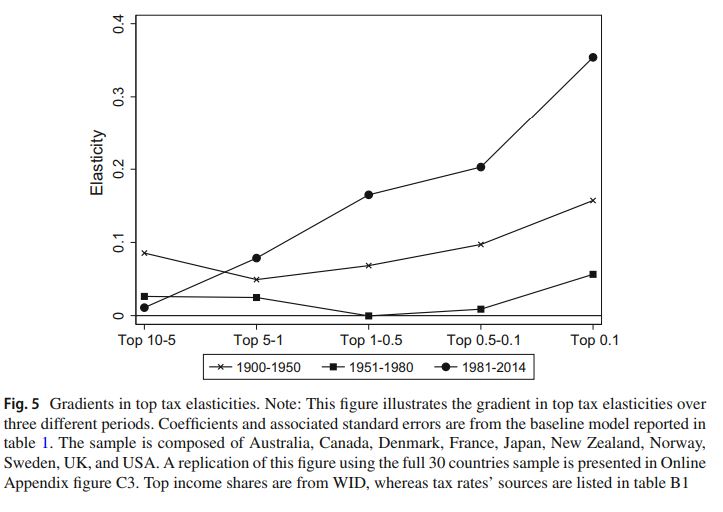
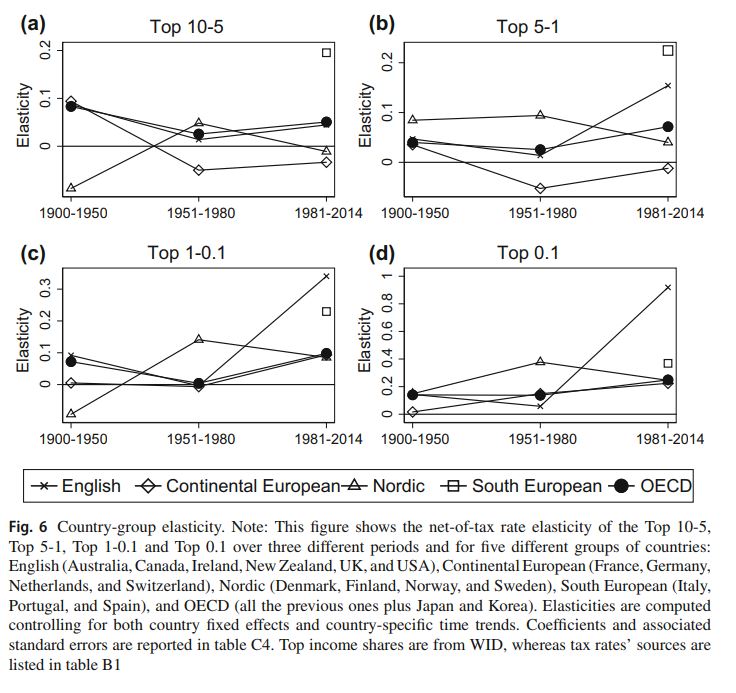
A new paper by Enrico Rubolino (University of Essex) and Daniel Waldenstrom (Paris School of Economics) forthcoming in International Tax and Public Finance compiles more than a century of data on gross income before taxes and transfers for up to 30 industrialized countries. They estimate a net-of-tax rate regression on the share of total gross income held by a given percentile, yielding an estimate that is intended to show how sensitive income at the top is to top marginal income tax rates. Of course, with such a long time span, the devil of this analysis will be in the details of data construction. I’m going to skip that and just show some of the figures.

How have the raw data of interest evolved over time? Inversely to one another:

ITAX1

Across the board, tax elasticities have been climbing since the 1980’s.

ITAX2

The last 40 years have seen a rising tax elasticity through the top 5 percent:

ITAX4

How have tax elasticities differed over time by major geographies? English speaking countries stand out in recent years.

ITAX5

There is much more drilling down in the paper. Here is the abstract:

We construct a cross-country dataset spanning 1900–2014 to estimate the tax elasticity of top incomes. Our results show that top tax elasticities vary tremendously over time; they were medium to low before 1950, dropped to almost zero during the postwar era and increased to unprecedented levels since 1980. We document a marked income gradient of increasing tax responsiveness at the top. Tax avoidance, especially income shifting between wage and capital income, appears to be one important driver of these patterns. Wars, financial crises, and country-specific effects and trends also have a bearing on top elasticities.


Call for Papers: “Ready or Not? Post-Fiscal Crisis/Next Fiscal Crisis” in May 2019

The University of Illinois-Chicago’s new Government Finance Research Center (College of Urban Planning and Public Affairs) has announced that it will continue the spring public finance miniconference series. The conference will be Thursday May 2 to Friday May 3 in 2019 and will take place at the Federal Reserve Bank of Chicago.

From the call:

Although the Great Recession ended a decade ago, many city governments have yet to see their revenue streams return to pre-recessionary levels. In addition, local governments across the United States, as well as many states, are grappling with the cost of legacy liabilities, meeting service demands, creating sustainable fiscal systems, and ensuring efficiency and equity in the design of fiscal models and programs. As such, there is concern about how well equipped state and local governments are to weather the next economic downturn, which many market watchers are predicting. The field of public finance is also being challenged to think about these issues in conjunction with concerns of social justice, intergenerational equity, place-based equity, and income and other disparities.

This conference will focus on topics that we think will be front and center in the policy debate in the coming years. We invite proposals for papers that examine these and other policy issues at the national and subnational levels in domestic and international contexts utilizing a variety of methodological approaches. Proposals will be reviewed and competitively selected.

Possible areas include, but are not limited to:
• Preparation for the next financial downturn
• Legacies of austerity
• Constraints on fiscal policy behavior and service provision
• Gendered or raced impacts of particular tax or revenue-generating policies
• Cost and consequences of deferred maintenance
• Changing fiscal fortunes of suburban communities

The deadline for proposals is February 1, 2019, see the call for further details.

This is the 5th of an informal miniconference series, which SPEA of Indiana University and AYS of Georgia State University have alternately hosted since 2015, so it is great to see the line-up expand to include UIC, and hopefully that continues.

Here are the most recent previous programs:

Spring 2018 at GSU: “Public Finance and The New Economy
Spring 2017 at IU: “Applied Research in Public Finance