*Political Budget Cycles and the Civil Service*

One of my internal motivations for starting this blog was to have a commitment device for staying current and broad in the public finance literature. One of the surprises that has come of this venture is the amount of good research on political budget cycles, a subject that I thought was basically dead. A year ago, I would have thought political budget cycle research was basically non-existent and what remained likely to be uninteresting.

The July issue of JPubE posses another example of how wrong I was in “Political Budget Cycles and the Civil Service: Evidence from Highway Spending in US States” by David Bostashvili (Amazon) and Gergely Ujhelyi (University of Houston). Here is the abstract

We study political budget cycles in infrastructure spending that are conditional on bureaucratic organization. Bureaucrats can facilitate or hinder politicians’ ability to engage in voter-friendly spending around elections. To test this idea, we use civil service reforms undertaken by US states in the second half of the 20th century to study political budget cycles in highway spending under civil service and patronage. We find that under patronage, highway spending is 12% higher in election years and 9% higher in the year before an election. By contrast, under civil service highway spending is essentially smooth over the electoral cycle. These findings provide a novel way through which civil service rules can stabilize government activity.

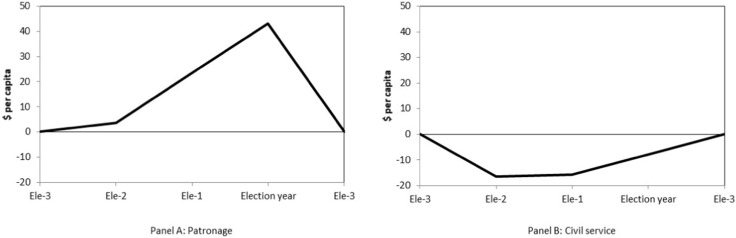
Of course if you’re still with me, you’re wondering how the authors define and identify “patronage” and “merit” systems in the states. The answer is that the authors are actually studying  the adoption of merit system adopted throughout the 20th century that mimicked legislation at the state level. These acts included a competitive civil service exam, prohibited mandatory political services from employees, and established a bipartisan civil service commission. Therefore, “patronage” systems are states that did not adopt those laws. Here is a neat preliminary figure the presents per capita highway spending over the state electoral cycle from 1960-1995 in the 44 states with 4-year election cycles:
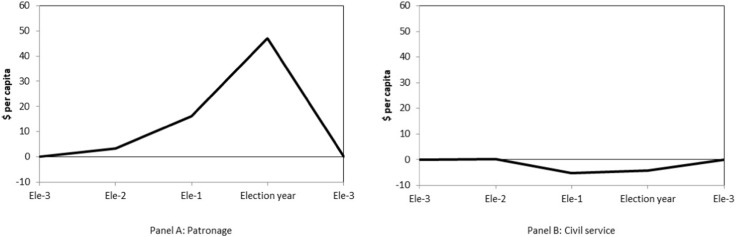
1-s2.0-s0047272719300635-gr1

And if you compare the 11 states that switch during their study period from patronage to merit, here is how they compare before and after:
1-s2.0-s0047272719300635-gr2

The rest of the paper goes on to show that this analysis holds up when you use a regression to control for other factors so that you get these graphs but with confidence intervals.

Score one for the Deep State.
Fiscal Limits with Voter Overrides

A prominent feature of subnational governments in the US is that they face legal constraints that prevent them from raising taxes or spending levels by any amount they may want. Indiana, for instance, restricts the local budget levy to a fraction of statewide nonfarm personal income growth. There are ways to circumvent these limits, however, and a popular way is to allow for voter overrides. You will recognize this as something like “the city can increase its budget up to 5% without voter approval this year, but anything more than that will require a special voter referendum.”

A recent JPubE paper by Stephen Coate and Ross Milton investigates the optimal determination of the limits in the presence of voter overrides.

This paper studies optimal fiscal limits in the context of a simple political economy model. A politician chooses the level of taxation for a representative citizen but is biased in favor of higher taxes. A constitutional designer sets a tax limit before the citizen’s preferred level of taxation is fully known. The politician is allowed to override the limit with the citizen’s approval. The paper solves for the optimal limit and explains how it is impacted by the possibility of overrides. The paper also shows that the citizen’s welfare can be enhanced if the designer imposes a limit on the politician’s override proposals.

The authors take inspiration from the literature on the delegation problem, where an agent must choose a policy that impacts both principal and agent’s payoffs. The payoffs depend on a state of nature, which prior to the policy choice will only be observed by the agent. Here, the policy is the level of spending or taxation that impacts welfare of a representative citizen (the principal) and the politician (the agent) is assumed to be biased in favor of a larger spending. Coate and Milton extend this to determining the optimal fiscal limit, which sets up their main contribution: comparing to a extension where voters can override the limit. This is done by allowing the politician to propose a policy in excess of the limit which is subjected to the vote. If voters pass the proposal, this is adopted; if not they offer a second proposal which respects the limit. The primary tool here for the politician is agenda-setting power over the citizen. Here is their summary of the main results:

There are three main results. First, with overrides, the optimal limit is at least as stringent as without. […] Second, with overrides, the typical monotonic relationship in delegation models between the agent’s bias and the tightness of the limit does not necessarily arise. […] Third, the institutional arrangement consisting of a limit and an override provision can always be strictly dominated by an arrangement that also specifies an override limit. Limiting the proposal the politician can make at the override stage prevents him from fully exploiting his agenda-setting power. The availability of an override limit changes the calculus underlying the regular limit. Since a limit increases the benefit of overrides, the regular limit is often tighter, making overrides more likely.

NTA Spring Symposium 2019

It starts tomorrow at the National Press Club in Washington DC. I’ll be there both days and presenting on Friday, so say hello if you see me around.

THURSDAY, MAY 16

8:45-9:00 am

WELCOME AND INTRODUCTION

Andrew Lyon, President, National Tax Association

9:00-10:30 am

UNCERTAINTY (A Panel Discussion)

Organizer: Kyle Pomerleau, Tax Foundation
Moderator: Richard Rubin, The Wall Street Journal
Panelists: 
Jennifer Blouin, The Wharton School, University of Pennsylvania
Chye-Ching Huang, Center on Budget and Policy Priorities
Jeff Wrase, Senate Finance Committee

10:30-10:45 am

BREAK

10:45-12:15 pm

UNFUNDED RETIREMENT LIABILITIES

Organizer: Jean-Pierre Aubry, Center for Retirement Research at Boston College
Moderator: Ranjana Madhusudhan, New Jersey Department of the Treasury

Will Pensions and OPEBs Break State and Local Budgets An Update (SLIDES)

Jean-Pierre Aubry, Center for Retirement Research at Boston College

How to Pay for Social Security’s Missing Trust Fund(SLIDES)
Geoffrey Sanzenbacher, Center for Retirement Research at Boston College

The Public Finance of State and Local Pension Sustainability
Jamie Lenney, Bank of England, Byron Lutz, Board of Governors of the Federal Reserve System, and Louise Sheiner, Brookings Institution

Discussant: Richard Johnson, Urban Institute

12:15-1:45 pm

LUNCHEON

Speaker: Lael Brainard, Member of the Board of Governors of the Federal Reserve System
Presentation of Davie-Davis Award for Public Service

2:00-3:30 pm

TCJA’S INTERNATIONAL PROVISIONS—REFLECTIONS ON THE FIRST YEAR

Organizer: George Plesko, University of Connecticut (for the American Tax Policy Institute)
Moderator: Mindy Herzfeld, University of Florida

Has TCJA Changed the Geometry of International Tax Planning A Riff on Circles, Squares, and Triangles (SLIDES)
Michael Donohoe, University of Illinois at Urbana-Champaign, Gary McGill, University of Florida, and Edmund Outslay, Michigan State University

Discussants: 
Todd Castagno, Morgan Stanley
David Noren, McDermott Will & Emery LLP

3:30-3:45 pm

BREAK

3:45-5:15 pm

OVERLAPPING GENERATIONS MODEL ROUNDTABLE MODEL COMPARISONS FROM A STYLIZED SOCIAL SECURITY EXPERIMENT (SLIDES)

Organizer: James Mackie, Ernst & Young LLP
Moderator: Larry Kotlikoff, Boston University
Summary of Results: Kerk Phillips, Congressional Budget Office
Panelists: 
Seth Benzell, Boston University
John Diamond, Rice University
Richard Evans, University of Chicago
Jagadeesh Gokhale, Penn Wharton Budget Model
Rachel Moore, Joint Committee on Taxation
Brandon Pizzola, Ernst & Young LLP

5:15-6:15 pm

RECEPTION

FRIDAY, MAY 17

9:00-10:30 am

ALTERNATIVE REVENUE SOURCES AND SIN TAXES

Organizer: Dennis Zimmerman, American Tax Policy Institute (for the American Tax Policy Institute)
Moderator: Roberta Mann, University of Oregon Law School

Using Climate Policy To Address Inequality Rethinking the Green New Deal (SLIDES)
Aparna Mathur, American Enterprise Institute

States’ Growing Dependence on Sin Taxes
Richard Auxier and Lucy Dadayan, Urban-Brookings Tax Policy Center

Wealth Taxation and Policy Uncertainty
Daniel Hemel, University of Chicago Law School

Discussants: 
Len Burman, Urban-Brookings Tax Policy Center
Norton Francis, Director of Revenue Estimation, DC Office of the Chief Financial Officer
Jason Oh, UCLA School of Law

10:30-10:45 am

BREAK

10:45-12:15 pm

STATE AND LOCAL SALES TAXES IN THE POST-WAYFAIR ERA

Organizers: John Mikesell and Justin Ross, Indiana University
Moderator: Joseph Cordes, George Washington University

The Barriers Created by Complexity: A State-by-State Analysis of Local Sales Tax Laws in Light of the Wayfair Ruling 
Whitney Afonso, University of North Carolina

How Wayfair Changed Everything But Also Nothing (SLIDES)
Jared Walczak, Tax Foundation

After Wayfair What are State Use Taxes Worth (SLIDES)
John Mikesell and Justin Ross, Indiana University

The Pennsylvania Experience After Wayfair (SLIDES)
Amy Gill, Pennsylvania Department of Revenue

Discussants:
Ranjana Madhusudhan, New Jersey Department of Treasury
Felipe Lozano-Rojas, Indiana University

12:15-1:45 pm

LUNCHEON

Speaker: Dana Trier, Davis Polk & Wardwell

2:00-3:30 pm

DIGITAL TAXES

Organizer: Itai Grinberg, Georgetown University Law Center
Moderator: Itai Grinberg, Georgetown University Law Center

Recent Developments in Digital Services Taxes: The UK Debate
John Vella, Oxford University

The Superiority of the Digital Services Tax to Significant Digital Presence Proposals (SLIDES)
Wei Cui, University of British Columbia

Superiority of the VAT to Turnover Tax as an Indirect Tax on Digital Services (SLIDES)

Superiority of the VAT to Turnover Tax as an Indirect Tax on Digital Services (Paper)

Karl Russo, PricewaterhouseCoopers LLP

What Do We Know About Global Residual Profit Allocation? A First Assessment of its Efficiency and Revenue Impact
Sebastian BeerRuud de MooijShafik HebousMichael Keen, and Li Liu, International Monetary Fund

New Issue of Public Finance Review (May 2019)

The new issue announces the Outstanding Paper Award of 2018, which goes to Johsua M. Congdon-Hohman for “Retirement Reversals and Health Insurance: The Potential Impact of the Affordable Care Act.

Here are the new articles:

State Rainy Day Funds and Government General Fund Expenditures: Revisiting the Stabilization Effect
Wenchi Wei and Dwight V. Denison

Local Governments and Economic Freedom: A Test of the Leviathan Hypothesis
Adam A. Millsap, Bradley K. Hobbs, and Dean Stansel

Growth Effects of VAT Evasion and Enforcement
Chandler McClellan

Vertical Grants and Local Public Efficiency: The Inference-disturbing Effect of Fiscal Equalization
Ivo Bischoff, Peter Bönisch, Peter Haug, and Annette Illy

Population Shifts and Discrete Public Services: Rationing Rules and the Support for Public Goods
Todd L. Cherry, Stephen J. Cotten, and Michael McKee

Spatial and Dynamic Features of Land Value Capture: A Case Study from Bogotá, Colombia
Néstor Garza

A Replication of “Is Public Expenditure Productive?” (Journal of Monetary Economics, 1989)
Christopher Clarke and Raymond G. Batina

Call for Papers: VIII Ibero-American Conference on Local Financing (Mexico City)

The conference is October 1-2, 2019, hosted by the Universidad Iberoamericana and the Center for Economic Reserach and Teaching (CIDE).

The Conference continues a joint initiative of academics and policy specialists in local finance that began in Spain in 2011 and subsequently continued in Argentina (2013), Brazil (2014), Chile (2015) , Spain (2016), Argentina (2017), and Colombia (2018).

The objective of the conference is to present a maximum of twelve research papers on topics related to: 1.Fiscal decentralization; 2. Efficiency and quality of sub-national welfare expenditures including public investments; 3. Subnational  tax collection; 4. Management of Sub-national Governments; 5. Debt and subnational financing; and 6. Subnational financing frameworks for climate change within Ibero-American countries (Latin America and Spain).

In previous conferences, a total of 92 papers have been presented, showing a great thematic and geographical coverage, adding to the growing importance of local finances in Latin America and the Caribbean, both in the research agendas and in policy matters. The ultimate goal is to create evidence based policy to improve fiscal systems in the region.

The call for papers seeks research and unpublished studies that, within the general themes listed above, to disclose new findings and research advances on local financing issues in Ibero-American countries. Through an academic selection committee, research papers selected will be invited to present their work in Mexico City October 1 and 2, 2019. This includes travel support and lodging for one professional to participate in the conference.

While the sessions seek to exchange views and policy innovations,  professionals of think tanks, national budget authorities such as national ministries of finance, international organizations, local public officials, and finally academics and students of public policy and public administration, economics public and public finances will likely participate in the audience.  Additionally, a half day will be devoted to a “Workshop on the Challenges of Local Financing” and ideas will be exchanged on the definition of research topics to be addressed in the next JIFL.

Fill out this form to participate.

I appreciate professor Heidi Jane Smith (Universidad Iberoamericana) for both the notice of the conference and the translation above. Do note that the conference itself will be in Spanish.

*Higher Pay, Worse Outcomes? The Impact of Mayoral Wages on Local Government Quality in Peru*

That is the title of an article by Ricardo Pique (Ryerson University) in the Journal of Public Economics. Does raising salary for mayors result in better mayoral performance, or gentrify the pool of candidates in some way? Here is Pique on the evidence from Peru:

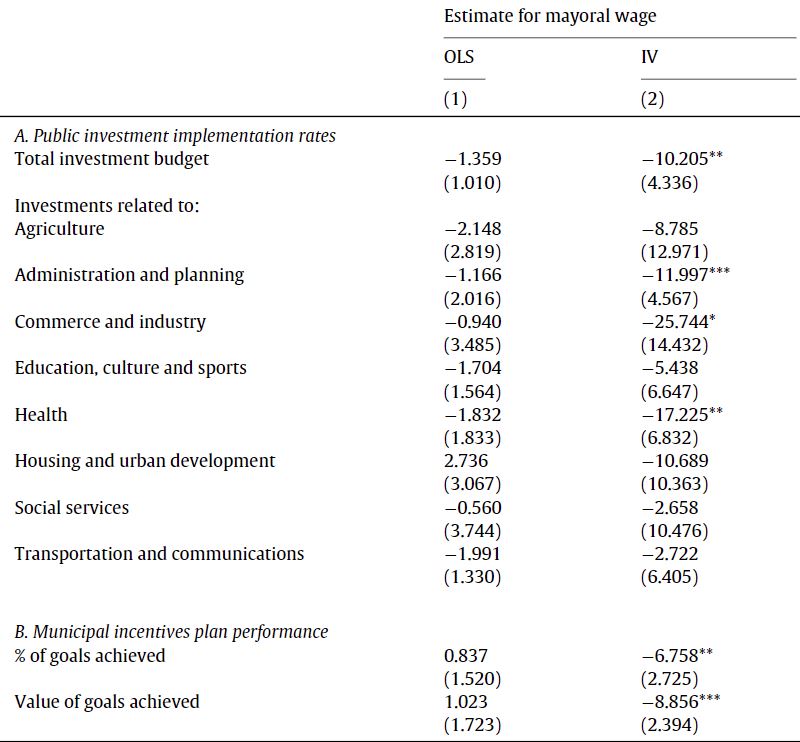
In this paper, I study how wages earned by local politicians affect local government quality. To identify the effects, I use caps imposed by the Peruvian central government on mayoral wages as an excluded instrument. The results show that mayoral wages do not improve government performance. In particular, there is a negative impact on public investment implementation and on performance goals set by the central government. Moreover, there is no evidence of a positive effect on politician selection, municipal bureaucratic capacity, and political effort. Wages do strongly affect the local political landscape, increasing political competition and reducing political support for the mayor. These changes may help explain the drop in performance as local authorities may face more political obstacles when implementing their policy agenda. Overall, the results show that higher politician wages need not improve local government quality.

To circumvent endogeneity, the instrument for actual wages paid is the maximum amount the Peruvian central government sets for mayoral wages (through a population based step function). So the identification is going to arrive from populations narrowly passing (or not) the threshold that allows them to offer higher mayoral wages.

Of course, evaluating public sector performance is an inherently difficult thing to do. There is a large cocktail of dependent variables, and they consistently show that they are negatively affected by getting the inducement into a higher wage. One of the author’s preferred outcome measures is a budget execution rate. According to Pique, Peruvian mayors are significant administrators of investment projects backed by the federal government, so he uses the share of the investment budget that was actually spent (“execution rate”). This was not very intuitive to me, so I’m just going to pull the explanation from footnote 38 on page 9:

Unlike other policy outcomes such as total revenue, investment implementation is within the mayor’s control. Local authorities are constantly pressured by both the central government and the local population to carry out their budgeted investment projects. Both national and local newspapers produce articles comparing the relative performance of local authorities in matters of public investment implementation. Failure to implement budgeted public investment projects can be particularly dangerous amid a weak institutional and political context. Ponce and McClintock (2014) show that low levels of implementation are correlated with more social protests.

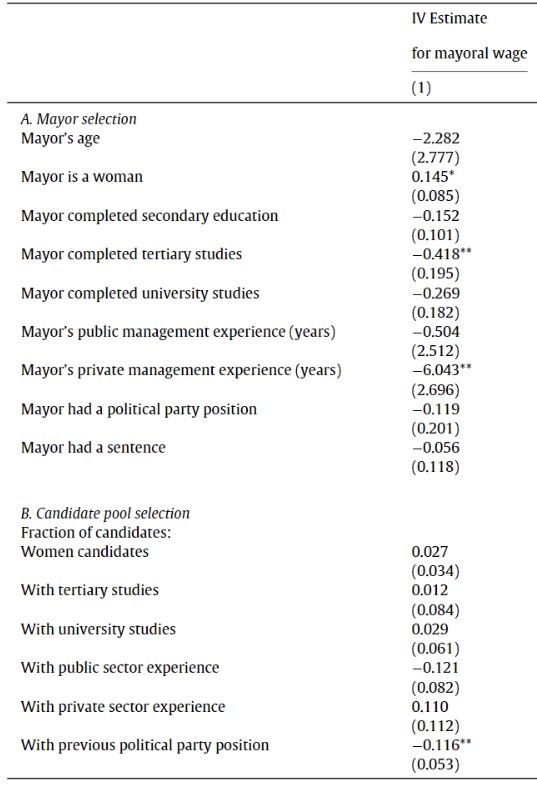
Here is a sampling of some of the main results, and of course the study has many robustness checks with a particular interest on whether this gets at performance:

mayerdepvariable

So, broadly, the effect on performance is negative. The question is why, and one possibility is that it undesirably changes the selection of mayors, so a variety of mayor and candidate for mayor attributes are effected by the wage offer. This does not appear to be the case:

mayorattributes

A number of other plausible outcomes are investigated, including bureaucratic capacity, political effort, and political competition, and it seems like political competition (increased number of parties, reduction in winner’s vote share, reduction in public sector experience) is the most plausible explanation in terms of why a change occurs, though it is not terribly clear why this reduces performance rather than increasing it. Pique says the pattern is perhaps most supportive of creating a rising obstructionist party at the local level and this might be a Peru specific outcome. The negative effects on getting mayors with public sector experience shows up in a variety of ways, and I’m somewhat inclined to think of that as an important finding towards explaining what is happening. In my opinion, public service motivation is underrated by the public (albeit overrated by public administration scholars)

There is much of interest and to admire in the paper. For background reading, perhaps consider Besley and Case’s (1995) QJE paper “Does Electoral Accountability Affect Economic Policy Choices?“.

*Political Parties Do Matter in U.S. Cities … For Their Underfunded Pensions*

That’s a new NBER working paper by Christian Dippel (UCLA), which finds that cities with Democratic mayors are more likely to underfund pensions:

Using data covering a wide range of municipal public-sector pension plans from 1962– 2014, I establish that unfunded pension benefits grow faster under Democratic-party mayors, using a regression discontinuity design (RDD) focusing on narrow mayoral races. Previous evidence shows that parties do not matter for a range of fiscal outcomes in U.S. cities, and suggests this is because Tiebout sorting imposes fiscal discipline. This paper shows that parties do matter for types of fiscal spending where benefits accrue to narrow constituencies and where costs are difficult to observe and understand for tax payers.

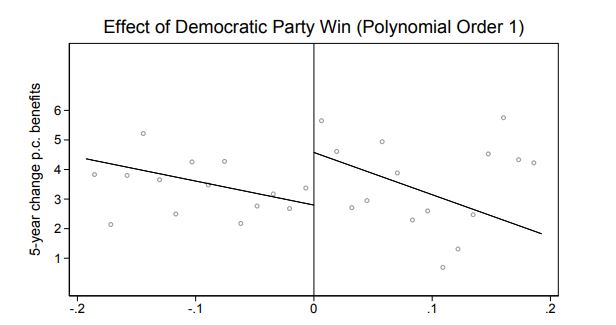
Generally the literature shows political parties does not much matter for local government finances, but as the authors here note those studies are typically exploring more visible fiscal outcomes. Here is the discontinuity for the main result (N=1,195):

MayorPension

The paper shows the finding to be robust to a number of subsamples, including plan type (police and fire-fighters), city system (mayor or council managers), and whether the mayor was a challenger or incumbent. The results are most pronounced for plan type, and as the figure shows, the effect is driven by being particularly close to the cut-off. These results imply that it is the result of pork barrel projects to win close elections. With any discontinuity there is concern that the threshold result will be different from the average treatment effect, so we should be a bit hesitant to think that states dominated with one party rule (i.e. no close elections) will have party differences in pension funding.


Trends in Public Support for a Federal Balanced Budget Amendment

Forthcoming in Public Budgeting & Finance is a paper by Andrew Crosby (Pace University) and Allyson Holbrook (University of Illinois-Chicago) titled “Public Support for a Balanced Budget Amendment to the U.S. Constitution: Trends and Predictors.” Here is the abstract:

Although researchers have explored policy attitudes in domains that require expertise (e.g., medicine), less research has explored policy attitudes related to economic policies that also require expertise to understand. This paper examines public opinion about a balanced budget amendment (BBA) to the U.S. Constitution. Using data from 38 national public opinion polls conducted over 36 years, we find that support for a BBA is related to respondent and contextual factors. Support for a BBA has become more polarized along party and ideological lines over time, and implications of a BBA for other policies affect people’s support for an amendment.

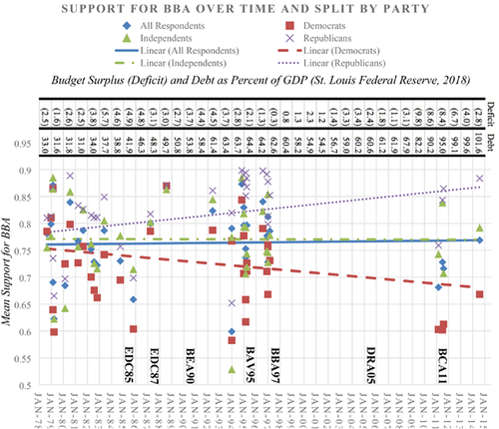
Crosby and Holbrook provide some determinants in a series of logit regressions, but I think the trends of the raw data are most interesting. Over time, they find that support for a BBA has generally been flat (even though the polls and survey methodology change over time), but high at around 76%. Interestingly, democrats have slightly reduced their support while republicans have increased, here is their Figure 1:

BBA

Public support is high here despite the fact that public finance scholars and economists are generally unfavorable toward such a policy. What is particularly interesting is that support is so high (and basically bi-partisan) yet we do not have such a policy. Amending constitutions are difficult, and perhaps if it was on the table support would go down as it became a subject they learned more about (making them more like economists). Another possibility is that parties avoid the topic. In Bryan Caplan’s Myth of the Rational Voter, heposits that politicians try hard to give voters what they want, but voters often want contradictory things. Here you could imagine an politician looking at BBA and reasoning “my voters want a BBA, but they also like being employed, and economists tell me these two are likely to be in conflict with one another; so long as voters don’t punish me too much for ignoring the BBA request I will protect their employment.”