*Political Parties Do Matter in U.S. Cities … For Their Underfunded Pensions*

That’s a new NBER working paper by Christian Dippel (UCLA), which finds that cities with Democratic mayors are more likely to underfund pensions:

Using data covering a wide range of municipal public-sector pension plans from 1962– 2014, I establish that unfunded pension benefits grow faster under Democratic-party mayors, using a regression discontinuity design (RDD) focusing on narrow mayoral races. Previous evidence shows that parties do not matter for a range of fiscal outcomes in U.S. cities, and suggests this is because Tiebout sorting imposes fiscal discipline. This paper shows that parties do matter for types of fiscal spending where benefits accrue to narrow constituencies and where costs are difficult to observe and understand for tax payers.

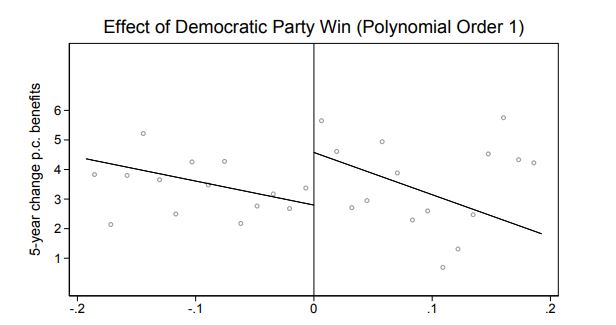
Generally the literature shows political parties does not much matter for local government finances, but as the authors here note those studies are typically exploring more visible fiscal outcomes. Here is the discontinuity for the main result (N=1,195):

MayorPension

The paper shows the finding to be robust to a number of subsamples, including plan type (police and fire-fighters), city system (mayor or council managers), and whether the mayor was a challenger or incumbent. The results are most pronounced for plan type, and as the figure shows, the effect is driven by being particularly close to the cut-off. These results imply that it is the result of pork barrel projects to win close elections. With any discontinuity there is concern that the threshold result will be different from the average treatment effect, so we should be a bit hesitant to think that states dominated with one party rule (i.e. no close elections) will have party differences in pension funding.


Tipping the scales: The causes and consequences of administrative spending

An early view article in Public Administration by Darnley et al. evaluates the relationship between external environments of public organizations and administrative intensity. The sample consists of four‐year public universities in the United States from 1998 to 2011. This period is particularly important due to, arguably, growing and excessive levels of “administrative bloat” at public universities in the United States. Such administrative intensity, the authors find, is significantly related to student outcomes.

“Administrative bloat” or intensity “generally refers to the bureaucratic component of an organization and is often measured through relative spending or number of employees.”

Public universities in the US operate in increasingly political environments that may have an impact on organizational size and complexity. External pressure variables such as party control of the state executive and legislative branches, and whether public universities operating in environments with centralized governing boards, are found to be significant covariates of two measures of administrative intensity levels: administrative costs and administrative personnel.

Darnley et al. state that: “Our main independent variables focus on factors in the external political environment. First, we hypothesize that institutions in states with more conservative political principals will face greater pressure to reduce administrative intensity, as these are often issues discussed in conservative platforms (at least in the context of the United States). As a result, we expect that institutions in more conservative states will have fewer staff and spend less on administration than those in states with more liberal political principals.”

This snapshot from Table 2 contains empirical results.

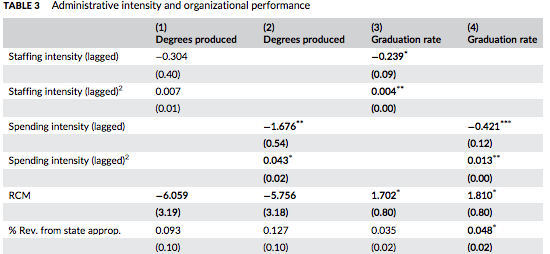
The authors further investigate an association between administrative intensity and student outcomes. Though, Darnley et al. argue that this is secondary in their study, for public universities student outcomes are critical. Their empirical results show that spending intensity is significantly related to degrees produced and student graduation rates. A snapshot from Table 3 contains these findings.

Trends in Public Support for a Federal Balanced Budget Amendment

Forthcoming in Public Budgeting & Finance is a paper by Andrew Crosby (Pace University) and Allyson Holbrook (University of Illinois-Chicago) titled “Public Support for a Balanced Budget Amendment to the U.S. Constitution: Trends and Predictors.” Here is the abstract:

Although researchers have explored policy attitudes in domains that require expertise (e.g., medicine), less research has explored policy attitudes related to economic policies that also require expertise to understand. This paper examines public opinion about a balanced budget amendment (BBA) to the U.S. Constitution. Using data from 38 national public opinion polls conducted over 36 years, we find that support for a BBA is related to respondent and contextual factors. Support for a BBA has become more polarized along party and ideological lines over time, and implications of a BBA for other policies affect people’s support for an amendment.

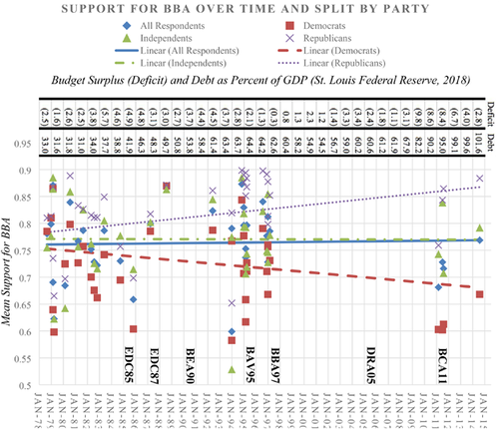
Crosby and Holbrook provide some determinants in a series of logit regressions, but I think the trends of the raw data are most interesting. Over time, they find that support for a BBA has generally been flat (even though the polls and survey methodology change over time), but high at around 76%. Interestingly, democrats have slightly reduced their support while republicans have increased, here is their Figure 1:

BBA

Public support is high here despite the fact that public finance scholars and economists are generally unfavorable toward such a policy. What is particularly interesting is that support is so high (and basically bi-partisan) yet we do not have such a policy. Amending constitutions are difficult, and perhaps if it was on the table support would go down as it became a subject they learned more about (making them more like economists). Another possibility is that parties avoid the topic. In Bryan Caplan’s Myth of the Rational Voter, heposits that politicians try hard to give voters what they want, but voters often want contradictory things. Here you could imagine an politician looking at BBA and reasoning “my voters want a BBA, but they also like being employed, and economists tell me these two are likely to be in conflict with one another; so long as voters don’t punish me too much for ignoring the BBA request I will protect their employment.”


Evidence on Local Political Budget Cycles from Tax Centralization

Available online at International Tax & Public Finance is “Switch toward tax centralization in Italy: a wake-up for the local political budget cycle” by Massimiliano Ferraresi, Umberto Galmarini, Leonzio Rizzo, and Alberto Zanardi. Here is the abstract:

Are the incentives to expand expenditure before local elections affected by the composition of local governments’ revenues? We explore this issue by exploiting the Italian government bill that in 2008 replaced the municipal tax on main residence with a vertical transfer. Relying on staggered dates of municipal elections to identify the effect of the reform, we find evidence of a political budget cycle, but only for municipalities that in 2008 were in their pre-electoral year. The result suggests that a lower degree of municipal tax autonomy strengthens the incentives to expand the size of the budget before the elections.

You get a sense of the identification strategy from the abstract, but it seems worth noting that the paper finds support for political budget cycle in the broadest terms — that the revenues and expenditures are correlated with election cycles — than any specific political budget cycle theory. In particular, they find that after centralization both current expenditures and revenues from charges/fees increased by equivalent amounts. Under some theories of political budget cycles, governments become more deficit prone as they cut taxes and increase spending just prior to the election cycle to protect incumbents, but that isn’t obviously occurring here. The authors seem to think it is a relative change in the political price for own source revenues that translates into spending:

Our interpretation of the result is that the primary channel through which the reform prompted incentives for expanding the budget in pre-electoral years was by lowering the costs for financing expenditure increases with own revenue sources. Before the 2008 reform, the three main sources of own revenues of Italian municipalities were the property tax on main residence, whose burden is entirely borne by residents who are also voters at the local level, users’ fees and charges, whose burden is mostly borne by residents directly benefiting from municipal services, and the property tax on additional residence, whose burden is in some cases mostly borne by non-residents, as in municipalities located in touristic areas. Since taxing the main residence is highly unpopular, before 2008 most municipalities applied tax rates on main residence just above the minimum level imposed by the central government, while they exerted more effort in the taxation of additional residences and in the determination of fees and charges, though the room to rely heavily on the latter was narrow, since residents were already taxed on main residence. Under these conditions, local administrators had little capacity of making leverage on own revenues to finance expenditure expansions for electoral purposes. The 2008 reform changed the setting. By relieving local administrators from having to impose a burden on residents on their main property, and by substituting the revenue loss with a compensating transfer, the reform considerably reduced the political costs incurred by local administrators to make leverage on user fees and charges to finance pre-electoral expenditure hikes.

I’ve previously blogged recent research on PBCT in the post Research on Overlapping Political Budget Cycles.

New Issue of Public Finance Review

The March 2019 issue of Public Finance Review has been published:

Integrating Microsimulation Models of Tax Policy into a DGE Macroeconomic Model
Jason DeBacker, Richard W. Evans, and Kerk L. Phillips


Relative Tax Rates, Proximity, and Cigarette Tax Noncompliance: Evidence from a National Sample of Littered Cigarette Packs
Shu Wang, David Merriman, and Frank Chaloupka
Social Security and Saving: An Update
Sita Slavov, Devon Gorry, Aspen Gorry, and Frank N. Caliendo
Consumption Taxes, Income Taxes, and Revenue Sensitivity: States and the Great Recession
Howard Chernick and Cordelia Reimers
Does Foundation Giving Stimulate or Suppress Private Giving? Evidence from a Panel of Canadian Charities
Iryna Khovrenkov
Impact of Tax and Expenditure Limits on Local Government Use of Tax-supported Debt
Sharon N. Kioko and Pengju Zhang
Equilibria and Location Choice in Corporate Tax Regimes
Ben J. Niu

For Teaching Notes: Political Rhetoric

I teach public budgeting & finance as part of the core in our MPA program. Budgets are a managerial tool, but also a exercise in persuasion. Justifications are required on the terms of the decision makers, not your own. For that reason, I did a segment on political rhetoric (slides annotated with comments downloadable here) with an emphasis on three topics:

  1. Traps in Talking Past One-Another
  2. Logical Fallacies
  3. Diagramming Arguments

I like to imagine these help contribute to a more civil and higher quality discourse. Feel free to make use of the slides (would appreciate knowing if you do), and I would welcome any feedback. A little about each topic…

Traps in Talking Past One-Another

If you and your counter party cannot understand each other you won’t get very far in persuasion. Furthermore, if you have at least a working understanding of the ideology you are dealing with (not their caricature), you can choose the more favorable frames and better anticipate their questions. I had the students read Arnold Kling’s Three Languages of Politics, which is $4 at Amazon or free at Cato, so in lecture we went through a news article on privatized firefighting in California.

Discussions of what constitutes a “Right” is another pitfall, so I provided the positive and negative right dichotomy, which is another good working conceptualization of rights provided you don’t overthink it.

Lastly, I discussed anecdotes. Anecdotes are perhaps the lowest status form of evidence, which is interesting in part because as a professor (a high status position in the world of evidence dispensaries) I use anecdotes all the time to teach. I think the problem is one of conflating the use of anecdotes to make a logical point versus a statistical one. I think gun control and border immigration control are good examples where groups talk past one another (perhaps deliberately) by differences in the intention of their anecdotes.

Logical Fallacies

There are hundreds of fallacies, but I went with ones I felt were most common in public economics debates:

  • Genetic Fallacy
  • Sunk Cost Fallacy
  • Ecological Fallacy
  • Fallacy of Composition
  • False Analogy
  • Ad hominem
  • Motte and Bailey Tactic
  • False Indicator Fallacy (Ok, I made this one up, it probably is already nested in another fallacy)
  • Appeal to Tradition
  • Post hoc ergo propter hoc
  • Politician’s Syllogism
  • Argument from Ignorance
  • Fallacy Fallacy

Diagramming Arguments

We finished with a overview on how to diagram an argument. Of course this is helpful in preparing your own argument and in critiquing others. I distributed the recent NYT op-ed by Saez and Zucman and had them try their hand at it before showing them a rough sketch of my own.

Call for Papers: 2019 Municipal Finance Conference at Brookings

From the call:

We are seeking papers for our 8th annual conference, to be held July 15-16, 2019, at the Brookings Institution. The Municipal Finance Conference aims to bring together academics, practitioners, and state and local government officials to discuss recent research on municipal finance and economic and fiscal issues affecting state and local governments more broadly. In recent years, paper topics have included changing rules for advance refunding, the impact of local newspaper closures on municipal borrowing costs, an analysis of the Kansas tax reform, pricing and ownership trends in U.S. green bonds, issues in financing public pensions, and changes in the municipal advisor market in the post Dodd-Frank era.

Understanding municipal markets means understanding what influences regional, state and local economic and fiscal conditions, so we are interested in a broad assortment of papers.

  • Deadline for proposals is Friday, March 1, 2019.
  • We are seeking proposals for a broad variety of topics on any aspect of state and local fiscal policy and finance.
  • Papers do not have to be original to this conference. We welcome papers that have been presented elsewhere.
  • Please send your proposal or abstract to Haowen Chen (hnchen@brookings.edu).
  • Selection decisions will be made by Friday, April 5, and drafts of selected papers will be due by Friday, June 7.

Additional details about the conference can be found on its website – check back for updates.

Fiscal Decentralization, Budget Discipline, and Local Finance Reform in Russia’s Regions

Russia has been in the news lately… A forthcoming article in Public Finance Review should help us all to cut through the noise and better understand public finances in that country. Alexeev et al. (2018) evaluate the relationship between fiscal decentralization and fiscal discipline in the Russian Federation using a panel for 2005-2013, especially in the context of 2009 public finance reforms. Alexeev et al. (page 3) write that:

“The main goal of this article is to use the data from Russian regions to estimate the link between intraregional fiscal decentralization and regional budget deficits. The important advantage of using Russian regional data is that the country has a relatively large number of regions and most (although not all) of the relevant fiscal data are publicly available. Also, as we show below (the first section and table 1), there is a large variation within the relevant fiscal variables, both across regions and over time.”

With respect to fiscal centralization, the authors also note that (page 10): “Fiscally, Russia is also one of the more centralized federal countries in the world, particularly on the revenue side. All taxes are collected by the federal tax service, which then channels tax revenues into the budgets of the appropriate level of government. By law, taxes in Russia are classified into federal, regional, and municipal depending on what level of government determines the base and the rates, although it is important to note that federal legislation imposes limits on the ability of lower levels of government to modify the base and the rates of “their” taxes. All revenue from regional taxes goes into regional or municipal budgets, but some of the revenue from federal taxes accrues to the budgets of the lower levels of government. The classification of taxes, the rules with respect to rate and base determination by various levels of government, and expenditure responsibilities are contained in Russia’s Tax Code, Budget Code, and certain other federal laws.”

Three major findings stand out in particular. First, expenditure decentralization is positively related to consolidated regional budget balances. Second, those regions with relatively greater levels of transfer dependence for municipalities tend to have greater levels of budget deficits. Finally, the 2009 public finance reform has limited the ability of regional governments to assign tax revenues to their municipalities, which appears to have had a negative impact on consolidated regional budget balances.

PFM Call for Papers: Symposium on Behavioral Public Finance

Public Finance & Management has issued a call for paper proposals for a symposium themed “Behavioral Public Finance: New Approaches to Old Questions.” The Guest Editors are Salvador Espinosa (San Diego State University), Wie Yusuf (Old Dominion University), and Kenneth Kriz (University of Illinois-Springfield). Attendees of last fall’s ABFM conference might have caught their roundtable on a similar theme. Below is the call.


The “rational” model of decision-making has traditionally been the lens through which public finance decisions and outcomes have been studied. In this model, rational actors evaluate all possible outcomes and make decisions based on the expected utility of the outcomes. Risk or uncertainty is assessed through using objective weights representing the probability of events, producing risk-adjusted measures of potential outcomes.

However, scholars like Tversky and Kahneman (1974), Thaler (1991) have proposed another theoretical framework to understand how individuals make decisions. Behavioral economics stresses that economic actors approach uncertain decisions through the use of heuristics because of the overwhelming complexity of evaluating the outcomes and probabilities of even relatively small problems. In essence, in the behavioral approach the weights used in the decision making process are not objectively determined but rather subjectively determined and are influenced by which heuristic is chosen.

McCaffery and Slemrod (2006) suggested a possible intersection between behavioral economics and public finance. Their proposal was to analyze broad clusters of questions concerning the forms of public finance mechanisms, problems of inter- temporal choice, and models of taxpayer compliance.  While there have been attempts to incorporate behavioral principles to address applied public finance questions (see e.g., Kriz, 2005, 2004; O’Connell and Yusuf, 2011; Yusuf, et.al., 2018 and Brunner, Robbins and Simonsen, 2018) , there is a need for further research demonstrating the application of behavioral economics and finance theories to public finance issues.

Recognizing this need, Public Finance and Management invites scholars to contribute to a symposium issue of the journal. We invite article submissions that explore the many dimensions of public finance behavior, either theoretically or empirically.

Potential topics include (but are not limited to):

  • Critical reviews of the pertinent literature;
  • Theories and models of decision-making and their applicability to the public finance and management field;
  • The effect of heuristics on public finance decisions;
  • The impact of biases on support for public spending or taxes, tax compliance issues approached from a behavioral lens; and
  • Behavioral approaches to public finance theory, and experimental results assessing public finance theories.

Proposals are due to kkriz4@uis.edu by February 28. Authors will be notified that they will be invited to submit a full manuscript by March 15. Final manuscripts are due August 15, 2019. Reviews and final acceptance will occur through October.

A ranking article of public finance journals including PFM can be found in the Journal of Public Economic Theory, 10 (1), 2008, pp. 55-76.

In addition, authors may choose to present (drafts of) their papers at the 11th Global Conference of the Forum for Economists International in Amsterdam, Netherlands, May 24-27, 2019 and receive comments additional to the peer review. Note that participation in the conference is optional and unrelated to the decision to accept or reject a manuscript for publication in PFM.
“The Impact of Dodd–Frank on True Interest Cost of Municipal Bonds: Evidence From California”

A forthcoming article in Public Budgeting & Finance by Mikhail Ivonchyk evaluates the impact of Dodd-Frank on the nature of financial advise in the municipal debt market—both as a disciplining factor and as a mechanism of weeding out bad advice from the market–, and as a result, lower cost of borrowing for California local governments. Central features of the Dodd–Frank Wall Street and Consumer Protection 2010 Act (Dodd-Frank Act) and directly relevant to municipal borrowing in the US are the governance provisions for municipal advisers (MA). Ivonchyk (page 2) writes that:

“The Dodd–Frank Act charged the U.S. Securities and Exchange Commission (SEC) with defining “municipal advisor” and the Municipal Securities Rulemaking Board (MSRB) with creating rules governing MA activities. The initiative was intended to increase fairness and transparency in the municipal debt market. The implementation of the MA registration requirement was postponed several times to allow market participants more time to analyze and prepare for the new rule. It finally took effect on November 1, 2014, implementing the Dodd–Frank requirement that all individuals and legal entities providing debt-related advice to municipal issuers register separately with both the SEC and MSRB. Under the law, MAs now have a fiduciary duty to place issuers’ interests ahead of their own. The SEC was granted certain enforcement tools to sanction violators. As of the rule’s effective date, financial advisors can no longer serve as underwriters in the same transaction, due to the conflict of interest. The Dodd–Frank Act will likely bear significant ramifications for the municipal securities market and fundamentally change market participants’ behavior.”

The author reasons that new requirements that MA’s keep records of their books and all written communications and agreements with municipalities, as well as details and contacts for all persons they have worked with within the past five years—and that these files are made available to the SEC at a known address—will ensure discipline among MAs. Moreover, to practice financial advisory functions, MAs must register with the SEC and become subject to fiduciary duties. Therefore, a process of weeding out the “charlatans” from the municipal market, paired with disciplining pressures from the regulators, may lower borrowing costs for municipal governments.

The findings appear to suggest that Dodd-Frank may have worked as expected, at least as it applies to governance of financial advisors. Ivonchyk (page 18) concludes that:

“The Dodd–Frank Act introduced substantial changes to the municipal securities market. Previously unregulated (but essential to municipal borrowers) financial services are now governed by the federal law. The new registration requirement and increased transparency and accountability of advisory activities were intended to weed out unqualified advisors, improve the quality of financial advice, and help municipal debt issuers raise capital more efficiently (Luby and Hildreth 2014, 96; White 2014).”

The table below presents estimates for cost savings for an average notional term bond due to Dodd-Frank.