Call for Papers: 2019 Municipal Finance Conference at Brookings

From the call:

We are seeking papers for our 8th annual conference, to be held July 15-16, 2019, at the Brookings Institution. The Municipal Finance Conference aims to bring together academics, practitioners, and state and local government officials to discuss recent research on municipal finance and economic and fiscal issues affecting state and local governments more broadly. In recent years, paper topics have included changing rules for advance refunding, the impact of local newspaper closures on municipal borrowing costs, an analysis of the Kansas tax reform, pricing and ownership trends in U.S. green bonds, issues in financing public pensions, and changes in the municipal advisor market in the post Dodd-Frank era.

Understanding municipal markets means understanding what influences regional, state and local economic and fiscal conditions, so we are interested in a broad assortment of papers.

  • Deadline for proposals is Friday, March 1, 2019.
  • We are seeking proposals for a broad variety of topics on any aspect of state and local fiscal policy and finance.
  • Papers do not have to be original to this conference. We welcome papers that have been presented elsewhere.
  • Please send your proposal or abstract to Haowen Chen (hnchen@brookings.edu).
  • Selection decisions will be made by Friday, April 5, and drafts of selected papers will be due by Friday, June 7.

Additional details about the conference can be found on its website – check back for updates.

Fiscal Decentralization, Budget Discipline, and Local Finance Reform in Russia’s Regions

Russia has been in the news lately… A forthcoming article in Public Finance Review should help us all to cut through the noise and better understand public finances in that country. Alexeev et al. (2018) evaluate the relationship between fiscal decentralization and fiscal discipline in the Russian Federation using a panel for 2005-2013, especially in the context of 2009 public finance reforms. Alexeev et al. (page 3) write that:

“The main goal of this article is to use the data from Russian regions to estimate the link between intraregional fiscal decentralization and regional budget deficits. The important advantage of using Russian regional data is that the country has a relatively large number of regions and most (although not all) of the relevant fiscal data are publicly available. Also, as we show below (the first section and table 1), there is a large variation within the relevant fiscal variables, both across regions and over time.”

With respect to fiscal centralization, the authors also note that (page 10): “Fiscally, Russia is also one of the more centralized federal countries in the world, particularly on the revenue side. All taxes are collected by the federal tax service, which then channels tax revenues into the budgets of the appropriate level of government. By law, taxes in Russia are classified into federal, regional, and municipal depending on what level of government determines the base and the rates, although it is important to note that federal legislation imposes limits on the ability of lower levels of government to modify the base and the rates of “their” taxes. All revenue from regional taxes goes into regional or municipal budgets, but some of the revenue from federal taxes accrues to the budgets of the lower levels of government. The classification of taxes, the rules with respect to rate and base determination by various levels of government, and expenditure responsibilities are contained in Russia’s Tax Code, Budget Code, and certain other federal laws.”

Three major findings stand out in particular. First, expenditure decentralization is positively related to consolidated regional budget balances. Second, those regions with relatively greater levels of transfer dependence for municipalities tend to have greater levels of budget deficits. Finally, the 2009 public finance reform has limited the ability of regional governments to assign tax revenues to their municipalities, which appears to have had a negative impact on consolidated regional budget balances.

PFM Call for Papers: Symposium on Behavioral Public Finance

Public Finance & Management has issued a call for paper proposals for a symposium themed “Behavioral Public Finance: New Approaches to Old Questions.” The Guest Editors are Salvador Espinosa (San Diego State University), Wie Yusuf (Old Dominion University), and Kenneth Kriz (University of Illinois-Springfield). Attendees of last fall’s ABFM conference might have caught their roundtable on a similar theme. Below is the call.


The “rational” model of decision-making has traditionally been the lens through which public finance decisions and outcomes have been studied. In this model, rational actors evaluate all possible outcomes and make decisions based on the expected utility of the outcomes. Risk or uncertainty is assessed through using objective weights representing the probability of events, producing risk-adjusted measures of potential outcomes.

However, scholars like Tversky and Kahneman (1974), Thaler (1991) have proposed another theoretical framework to understand how individuals make decisions. Behavioral economics stresses that economic actors approach uncertain decisions through the use of heuristics because of the overwhelming complexity of evaluating the outcomes and probabilities of even relatively small problems. In essence, in the behavioral approach the weights used in the decision making process are not objectively determined but rather subjectively determined and are influenced by which heuristic is chosen.

McCaffery and Slemrod (2006) suggested a possible intersection between behavioral economics and public finance. Their proposal was to analyze broad clusters of questions concerning the forms of public finance mechanisms, problems of inter- temporal choice, and models of taxpayer compliance.  While there have been attempts to incorporate behavioral principles to address applied public finance questions (see e.g., Kriz, 2005, 2004; O’Connell and Yusuf, 2011; Yusuf, et.al., 2018 and Brunner, Robbins and Simonsen, 2018) , there is a need for further research demonstrating the application of behavioral economics and finance theories to public finance issues.

Recognizing this need, Public Finance and Management invites scholars to contribute to a symposium issue of the journal. We invite article submissions that explore the many dimensions of public finance behavior, either theoretically or empirically.

Potential topics include (but are not limited to):

  • Critical reviews of the pertinent literature;
  • Theories and models of decision-making and their applicability to the public finance and management field;
  • The effect of heuristics on public finance decisions;
  • The impact of biases on support for public spending or taxes, tax compliance issues approached from a behavioral lens; and
  • Behavioral approaches to public finance theory, and experimental results assessing public finance theories.

Proposals are due to kkriz4@uis.edu by February 28. Authors will be notified that they will be invited to submit a full manuscript by March 15. Final manuscripts are due August 15, 2019. Reviews and final acceptance will occur through October.

A ranking article of public finance journals including PFM can be found in the Journal of Public Economic Theory, 10 (1), 2008, pp. 55-76.

In addition, authors may choose to present (drafts of) their papers at the 11th Global Conference of the Forum for Economists International in Amsterdam, Netherlands, May 24-27, 2019 and receive comments additional to the peer review. Note that participation in the conference is optional and unrelated to the decision to accept or reject a manuscript for publication in PFM.
The Fiscal Implications of Celebrity Governors

The Economics of Governing has published online “A Test of the Institutionally-Induced Equilibrium Hypothesis: On the Limited Fiscal Impact of Two Celebrity Governors” by Roger Congleton and Yang Zhou, both of West Virginia University. The paper looks at the election of Jesse Ventura and Arnold Schwarzenegger and as given away by the title it finds little impact on their state’s expenditures or deficits. From the introduction (footnotes omitted):

Our main interest in this study is the extent to which state level checks and balances tend to minimize the effects of changes in the individuals holding the post of governorship. The usual approach to do so empirically would be to adopt an international perspective and attempt to determine how differences in federal institutions affect a nation’s policies. An enormous body of international and intra-national empirical research supports the contention that institutions matter in the sense that they affect the kinds of policies adopted by a national government. Our approach is the reverse of the normal one in that we hold institutions constant and attempt to determine whether “shocks” in the forms of very unusual governors affect the fiscal policies of the states governed.

The main tool for the causal evidence is a new variant on the synthetic control method. Here is the full abstract:

The governorships of Jesse Ventura of Minnesota and Arnold Schwarzenegger of California provide two natural experiments for testing the institutionally induced stability hypothesis. Both men rose to their governorships through unique career and electoral paths that would reduce the stabilizing effects of partisan commitments and electoral competition, which would tend to increase their impact on public policy. Nonetheless, our evidence suggests that despite their unique backgrounds and paths to office neither governor had a statistically significant impact on their state’s expenditures or deficits.

Assuming one regards Trump as another celebrity executive, there is an interesting discussion to be had as to what can be learned from this study about the current federal government.

Joffe, Reck, and The Dream of Machine-Readable CAFRs

A new working paper by Marc Joffe (Public Sector Credit Solutions) and Jacqueline Reck (University of South Florida) has been released by the Mercatus Center on the feasibility of PDF to XBRL migration of CAFRS so that their content can be quickly and automatically imported into spreadsheets and databases:

Ten years after the Securities and Exchange Commission mandated the conversion of corporate financial statements to machine-readable formats, there is still no analogous mandate for state and local government Comprehensive Annual Financial Reports (CAFRs). We explore the challenges and benefits of migrating from PDF CAFRs to machine-readable filings using eXtensible Business Reporting Language (XBRL). After explaining the benefits of machine-readable audited municipal financial data, we consider the challenges of creating and implementing an XBRL taxonomy for this sector and the impact a filing mandate would have on state and local governments. To better assess the challenges, we update a CAFR taxonomy previously published by Neal M. Snow and Jacqueline L. Reck and apply it to a city in Florida. While corporate XBRL filers generally use third-party filing firms, they can also use open-source software, low-cost licensed software, or both to produce the filings. Providing a variety of low-cost alternatives to state and local governments helps mitigate the challenge of providing affordable filings.

I was curious about the benefits of this for governments that might persuade them to start voluntarily using XBRL. That is, the benefits to academics and monitoring agencies from being able to harvest mass data are clear, but I wasn’t sure what would be in it for governments doing the filing. Indeed, as their review shows, many of the beneficiaries of this are regulators (the SEC requires XBRL in the 10-K reports for public companies for this reason), so it looks to me like voluntary provision will likely remain the exception rather than the rule.

“State Taxes and Spatial Misallocation”

That’s the title of a paper in this month’s issue of The Review of Economic Studies by Pablo Fajgelbaum, Eduardo Morales, Juan Carlos Suarez Serrato, and Owen Zidar. Here is the abstract:

We study state taxes as a potential source of spatial misallocation in the U.S.. We build a spatial general equilibrium framework that incorporates salient features of the U.S. state tax system, and use changes in state tax rates between 1980 and 2010 to estimate the model parameters that determine how worker and firm location respond to changes in state taxes. We find that heterogeneity in state tax rates leads to aggregate welfare losses. In terms of consumption equivalent units, harmonizing state taxes increases worker welfare by 0.6% if government spending is held constant, and by 1.2% if government spending responds endogenously. Harmonization of state taxes within Census regions achieves most of these gains. We also use our model to study the general equilibrium effects of recently implemented and proposed tax reforms.

One of the tax reforms studied is the deduction on State and Local Taxes, which was reduced (n.b. not eliminated) in the Tax Cuts and Jobs Act:

Eliminating SALT would increase dispersion in tax payments, since places with high state taxes and high-income taxpayers would pay even higher taxes. Consequently, we find that eliminating SALT reduces welfare by roughly 0.6% and aggregate real GDP by approximately 0.3% if government spending is held constant, and by 0.8% and 0.4%, respectively, if government spending responds endogenously. Southeastern states experience the largest gains. The hardest hit states are those with a large share of high income people and high tax rates, especially in the Northeast.

Public Sector Economics 2019 Conference at the Institute of Public Finance (Croatia)

Abstracts are due May 1, 2019 and the conference is October 24th, 2019 in Zagreb, Croatia. From the conference site:

The Institute of Public Finance (IPF) and Friedrich Ebert Stiftung (FES) are organizing the conference Public Sector Economics 2019 – Wealth and property taxation: where do we stand? The goal of the conference is to provide a state-of-the-art assessment of the profession’s thinking on the potentials and limitations of these taxes and their role in the modern economy. We invite submissions of historical reviews, studies of experience, as well as theoretical, empirical and policy papers on different aspects of wealth and property taxation.
Wealth (or capital) taxes can be imposed on the holding, transfer or increase in the value of land, housing, financial, business, and other types of assets. Their forms include gross or net wealth taxes; estate, inheritance or gift taxes; housing ownership and rental income taxes; other real estate and property taxes; capital gains taxes and so on. Wealth taxes are far less widespread and generate much less revenue than they used to. Although taxes on property play a bigger role, overall property tax revenue remains limited in most countries.
Recently, there has been a renewed interest in wealth and property taxation. One reason has been a rapid growth in wealth across countries, on the one hand, and increasing wealth inequality on the other. Another has been the need for many governments to generate revenue in order to stabilise public finances in the aftermath of the global financial crisis. Separately, there is an ongoing debate about the impact of the favourable tax treatment of housing on resource allocation as well as macroeconomic and financial stability. Many countries have seen heated debates on estate or inheritance taxes: are they an efficient way to address wealth inequality, increase incentives to work and innovate, or do they encourage wealthy individuals to move to tax havens or engage in tax saving activities that create little value added?

Conference outline and topics

The conference will feature keynotes on historical experiences with wealth and property taxes, current state of property and wealth taxation, and how it might evolve in the future.
Relevant topics for the sessions may include:
  • Country experiences with wealth and property taxes, including administrative issues

  • Theory of wealth and property taxation: impact on economic behaviour, efficiency and fairness, trade-offs with other taxes

  • Taxation of land, housing and other immovable property, incidence of recurrent taxes on immovable property and property taxes in general

  • Taxation of property rental income

  • Estate, inheritance and gift taxes

  • Taxes on financial and capital assets

  • Fiscal and macroeconomic aspects of wealth and property taxes

  • Political economy of wealth and property taxes

  • Distributional aspects: impact of wealth and property taxes on wealth and income inequality, income in retirement

  • Property taxation and housing markets

  • Property taxation and local public finance

  • Property taxation and tourism, spatial and urban planning

“What Are the Determinants of Public Spending? An Overview of the Literature”

That is the title of a new paper by Francois Facchini (University of Paris) forthcoming in the Atlantic Economic Journal. The argument of the paper is that econometrics is not going to ultimately explain (at least on its own) the size of the public sector, but it also contains a useful summary on the history of thought. Here is the abstract:

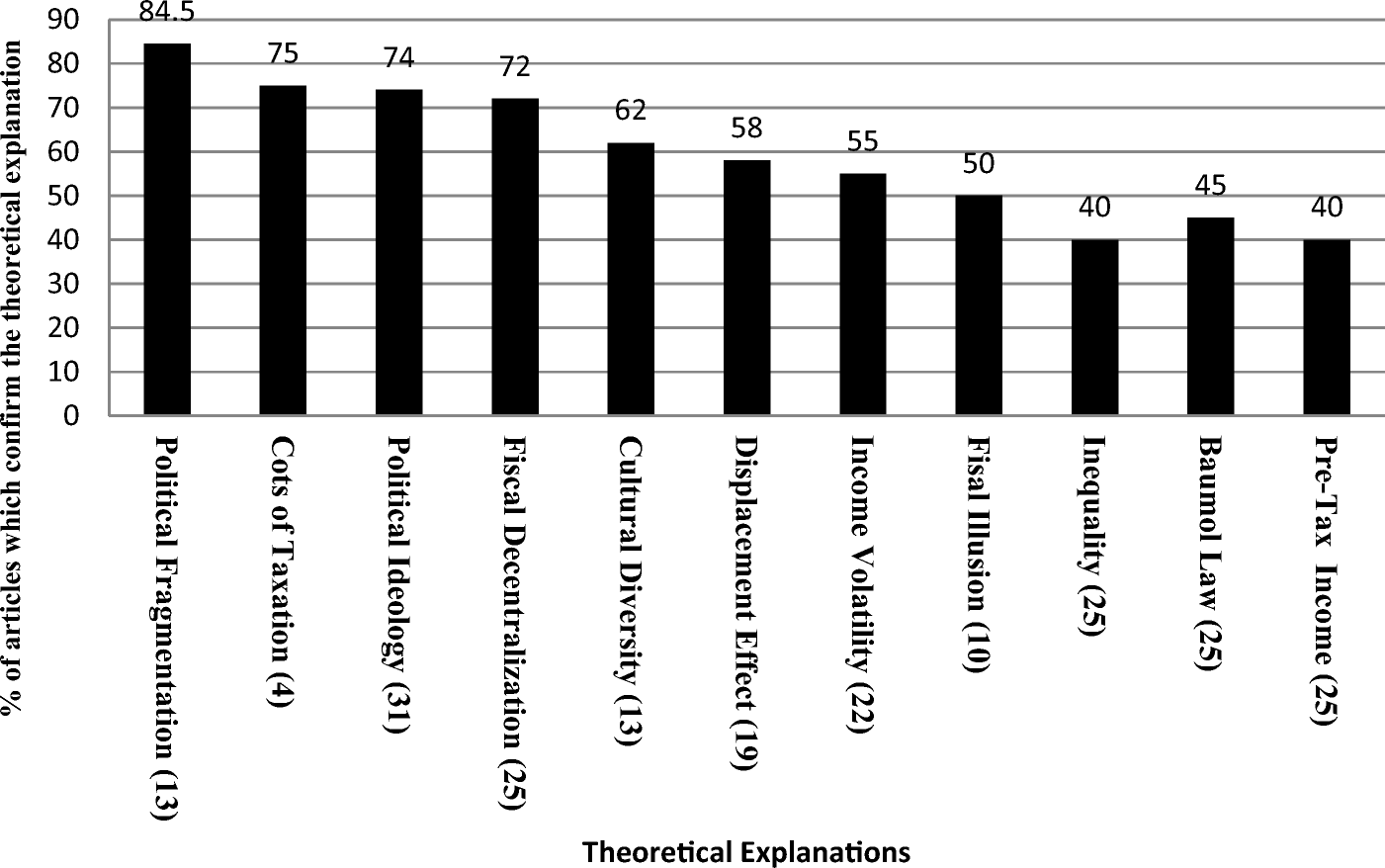
The purpose of this paper is to present and assess the literature about the determinants of public spending. Its originality is the adoption of a methodological perspective. Does econometrics allow economists to discover universal constants for public spending or is it only another way of writing the history of public finance? The economic theory of the size of government includes 23 explanations and 78 explanatory variables. The size of government reflects the preferences of citizens (demand model), the power of politicians and bureaucrats to impose their interests against citizens’ interests (supply model) and the constitutional design that governments face in raising revenue. Nonetheless, the great instability of econometric tests shows, all the difficulties of the science of public finance in finding a constant and discovering real causality between these variables. The analytical consequence of this result is the great futility of the search for a general law of the dynamic of public spending. This futility can be interpreted as a consequence of the complexity of political exchange. The size of the state is a multi-causal phenomenon. The prescriptive consequence is that it is not possible to use quantitative analysis to defend a form of “causal manipulationism” and predict the timing of state reforms and a political strategy to reduce the share of public spending in production. Econometrics is only one way of reporting the history of public finances.

This figure is also quite interesting, it shows concepts studied, the number of studies that confront them, and how frequently they seem to conform to theoretical expectations. Political fragmentation is the most commonly accepted hypothesis at 84%, while the base size of the economy as measured by pre-tax income has been the least likely to conform to expectations (40%):

11293_2018_9603_fig3_html

Regulation and Government Debt

New in Public Choice by Niclas Berggren and Christian Bjørnskov is evidence that more regulation in the market economy results in higher levels of public debt.

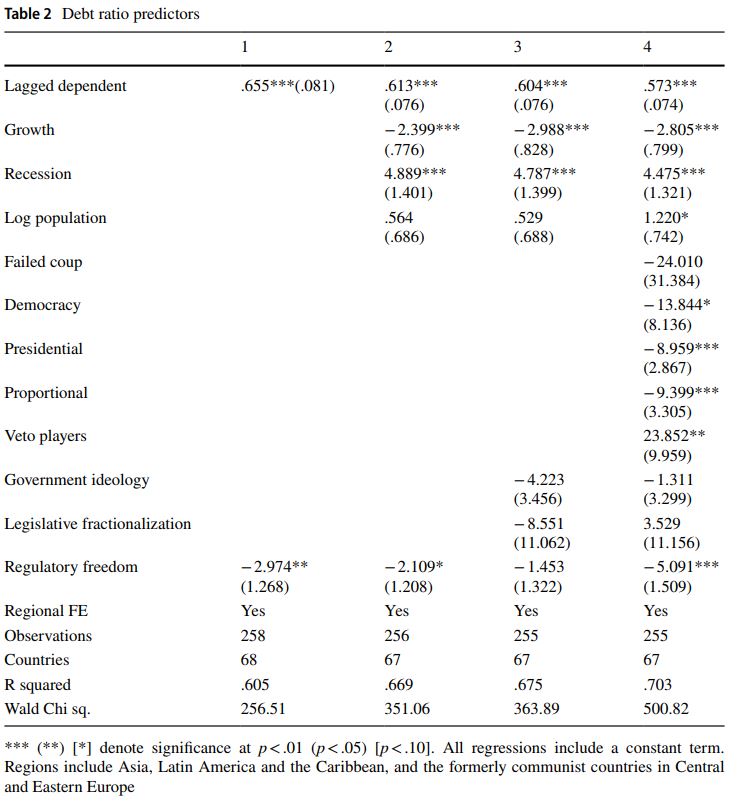
Government debt is large in most developed countries, and while budget deficits may reflect short-term attempts to kick-start the economy in times of crisis by means of fiscal stimulus, the longer-term consequences may be detrimental to investment and growth. Those negative consequences make it important to identify factors that are associated with public debt. While previous studies have related government debt to economic and political variables, they have not incorporated the degree to which the economy is regulated. Using a measure of regulatory freedom (absence of detailed regulation of labor, business and credit) from the Economic Freedom of the World index, we conduct an empirical analysis covering up to 67 countries during the period 1975–2010. The main finding is that regulatory freedom, especially with respect to credit availability, reduces debt accumulation. The effect is more pronounced when the political system is fractionalized and characterized by strong veto players, indicating policy stability and credibility, and when governments have right-wing ideologies.

This wasn’t very intuitive to me, so I’ll unpack the authors arguments a little bit here. By “debt accumulation,” the authors mean public debt as a percent of GDP (as opposed to per capita debt or total debt). I’m not crazy about that, as regulation plausibly affects GDP, but I’m not sure what a better way to scale it would be. Here is a preview of the theoretical explanation:

We propose that the extent to which an economy is regulated matters, on the basis of four theoretical links. The first is that people who hold pro-market attitudes tend to be opposed to public regulation of the private sector and hold skeptical views about substantial government debt. The second and third are that regulation affects the functioning of the economy in ways that influence debt, and that regulation may serve as a signal to lenders regarding contemporaneous or future problems in the economy or the government, such that they set interest rates (that influence debt levels) accordingly. Finally, a regulated economy may be comparatively inflexible and unable to adjust very well to changing macroeconomic circumstances, which could leave the government with incurring debt to counteract downturns as its only politically viable option.

The first link is probably true, but isn’t all that interesting as it is arguing that regulation is correlated with an omitted preference for government rather than being a causal factor in its own right. The other links are indirect in the sense that the regulation causes something else to happen and that something else also affects debt. This is usually the stuff that leads to structural modeling but that is not where this paper is going.

The last theoretical link is the most interesting I think, where the supply of regulation creates demand for additional government spending during recessions. My first thought was that more volatile economies (induced by regulation or not) should plausibly have governments more engaged with countercyclical policies that enable consumption smoothing. That should plausibly cause more short-term debt during downturns, but also greater rainy day fund balances (albeit it is not empirically obvious in looking at the American states).  However, the authors proposed mechanism for this link is a kind of political commitment where heavy regulation means the government is now more responsible for a well-functioning economy. Kind of a “you break it you bought it” style of commitment.  I’m not sure I believe that specific mechanism, but it does make some intuitive sense to me that a more regulated private economy that restricts access to private credit or slows down private capital reallocation will increase the government’s comparative advantage in borrowing over private citizens. That is, the larger the Okun Gap, the greater the gap in borrowing costs between the private and public sectors that might plausibly favor government-over-private borrowing.

The regression results hold up the association (see the last variable, “Regulatory freedom”) that less regulation implies less public debt, though the point estimate will halve or double as you start adding control variables, so we are a long way from a convincing causal estimate.

DebtRatio

Still, it is an interesting hypothesized mechanism, and it would be interesting to see if it would bear out in a cleverly designed citizen or policy maker experiment of some type.